Heap Data Structure Explained with Max Heap, Min Heap, Insertion, Deletion & Priority Queue
Introduction
When dealing with large datasets or systems where priority matters—like scheduling tasks or processing urgent requests—efficiency becomes critical. This is where the heap data structure proves its value.
Rather than keeping data fully sorted (which is expensive), heaps maintain just enough order to quickly access the most important element. This balance makes heaps a practical choice in many real-world applications.
Are you interested in visiting the previous lesson?
What is a Heap?
A heap is a specialized binary tree that follows two important rules:
- It must be a complete binary tree, meaning all levels are filled except possibly the last.
- It must satisfy the heap property, which defines the relationship between parent and child nodes.
Unlike a binary search tree, a heap does not enforce strict ordering across all nodes—only between parents and children.

Types of Heap
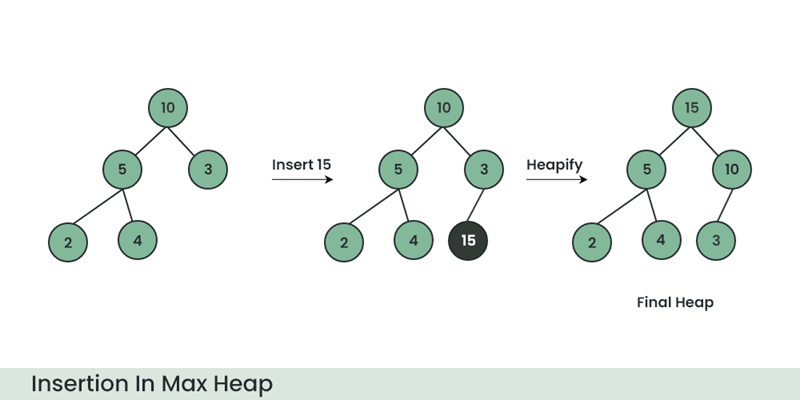
Max Heap
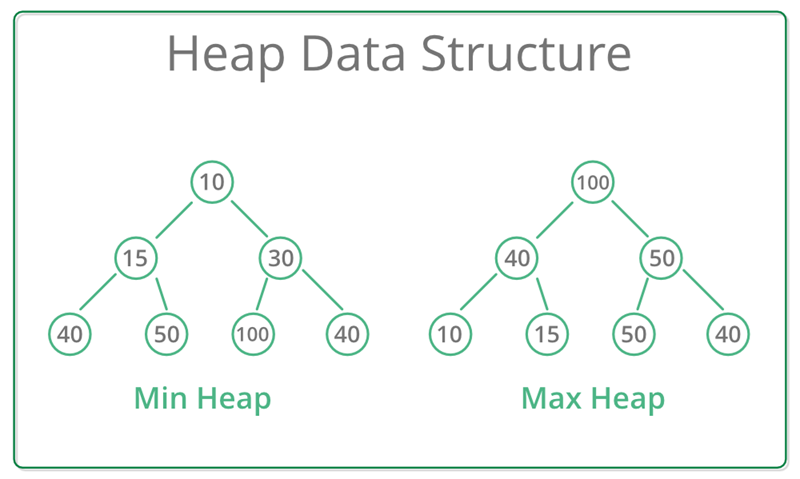
In a max heap, every parent node is greater than or equal to its children.
This means the largest element is always located at the root.
Where it’s used:
Think of a leaderboard system where the highest score should always be visible at the top.
Min Heap
In a min heap, every parent node is smaller than or equal to its children.
Here, the smallest element is always at the root.
Where it’s used:
Navigation systems use min heaps to quickly find the shortest path or minimum cost.
Heap Representation Using Arrays
One of the most practical aspects of heaps is that they can be stored in arrays without pointers.
For any element at index i:
- Left child →
2i + 1 - Right child →
2i + 2 - Parent →
(i - 1) / 2
This representation keeps implementation simple and memory-efficient.
Heap Operations
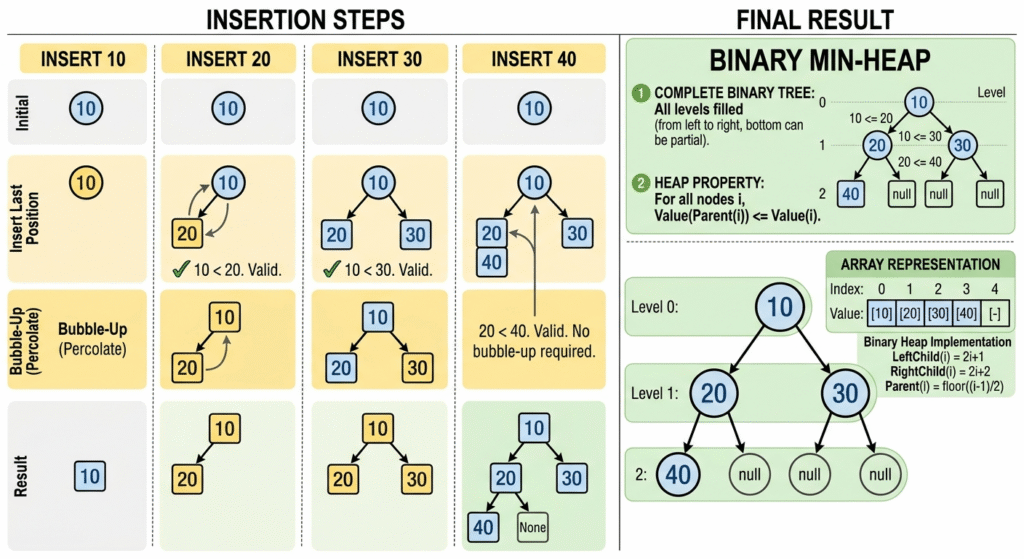
Insertion (Heapify Up)
When inserting a new element, it is placed at the end of the heap. From there, it moves upward until the heap property is restored.
Example scenario:
Imagine adding a new task with very high priority in a system. It quickly “bubbles up” to its correct position.
Insert in Min Heap: 10, 20, 30, 40
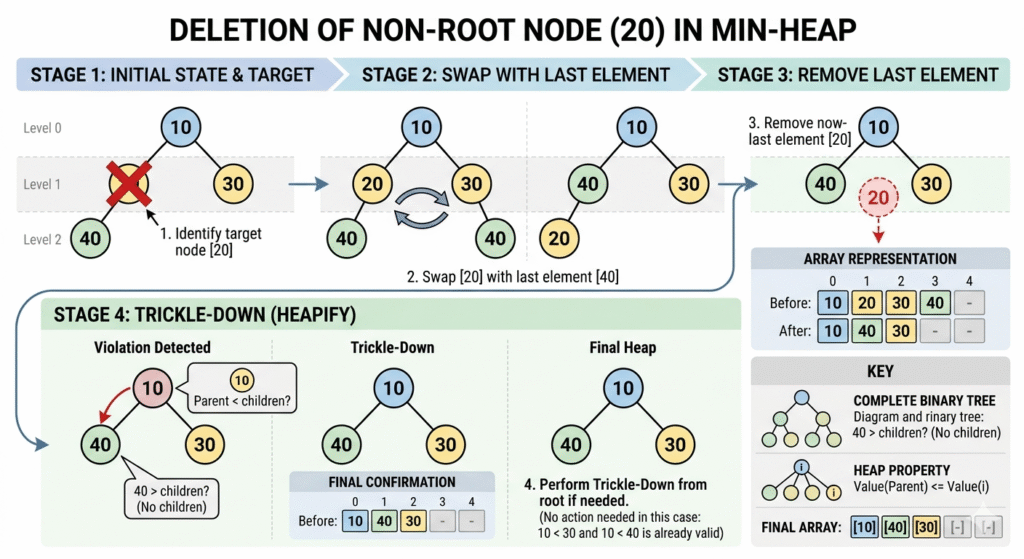
Deletion (Heapify Down)
Deletion usually removes the root element. The last element replaces the root, and then it moves downward to restore order.
Example scenario:
Once the highest-priority task is completed, the next most important task takes its place.
Delete 20 node in heap tree: 10, 20, 30, 40
Complete Code:
#include <iostream>
#include <vector>
using namespace std;

class MaxHeap {
    vector<int> heap;

    // Heapify down
    void heapify(int i) {
        int largest = i;
        int left = 2 * i + 1;
        int right = 2 * i + 2;

        if (left < heap.size() && heap[left] > heap[largest])
            largest = left;

        if (right < heap.size() && heap[right] > heap[largest])
            largest = right;

        if (largest != i) {
            swap(heap[i], heap[largest]);
            heapify(largest);
        }
    }

    public:
    // Insert element
    void insert(int val) {
        heap.push_back(val);
        int i = heap.size() - 1;

        // Move upward to maintain heap property
        while (i > 0 && heap[(i - 1) / 2] < heap[i]) {
            swap(heap[i], heap[(i - 1) / 2]);
            i = (i - 1) / 2;
        }
    }

    // Delete max element
    void deleteMax() {
        if (heap.empty()) {
            cout << "Heap is empty!\n";
            return;
        }

        cout << "Deleted element: " << heap[0] << endl;

        heap[0] = heap.back();
        heap.pop_back();

        if (!heap.empty())
            heapify(0);
    }

    // Get maximum element
    int getMax() {
        if (heap.empty()) {
            cout << "Heap is empty!\n";
            return -1;
        }
        return heap[0];
    }

    // Display heap
    void display() {
        if (heap.empty()) {
            cout << "Heap is empty!\n";
            return;
        }

        cout << "Heap elements: ";
        for (int x : heap)
            cout << x << " ";
        cout << endl;
    }
};

int main() {
    MaxHeap h;

    // Insert elements
    h.insert(10);
    h.insert(20);
    h.insert(30);
    h.insert(40);
    h.insert(50);

    h.display();

    // Maximum element
    cout << "Maximum element: " << h.getMax() << endl;

    // Delete max
    h.deleteMax();

    h.display();

    return 0;
}
Heap as a Priority Queue
A priority queue is a structure where elements are processed based on importance rather than arrival order.
Heaps are the most efficient way to implement this.
- Insert → O(log n)
- Delete → O(log n)
- Access top element → O(1)
This efficiency makes heaps ideal for systems that require frequent updates and quick access.
Real-World Scenarios
1. Operating Systems
CPU schedulers use heaps to decide which process should run next based on priority.
2. Emergency Services
Hospitals prioritize patients based on urgency—critical cases are handled first.
3. Online Ride-Hailing Apps
Matching drivers with nearest passengers involves selecting the minimum distance quickly.
4. Stock Market Systems
Buy/sell orders are often prioritized using heap-like structures.
Time Complexity Analysis
| Operation | Complexity |
|---|---|
| Insertion | O(log n) |
| Deletion | O(log n) |
| Access Root | O(1) |
This predictable performance is why heaps are preferred in performance-critical applications.
Advantages and Limitations
Advantages
- Efficient for priority-based operations
- Simple array implementation
- Consistent performance
Limitations
- Not suitable for searching arbitrary elements
- Does not maintain full sorting
Practical Example Walkthrough
Consider inserting the values:10, 20, 5, 30
Step-by-step:
- Insert 10 → becomes root
- Insert 20 → moves above 10 (max heap)
- Insert 5 → stays as child
- Insert 30 → moves to the root
This dynamic restructuring ensures the heap property is always maintained.
Conclusion
The heap data structure offers a smart balance between order and efficiency. It does not try to fully sort data but ensures that the most important element is always accessible.
From operating systems to navigation systems, heaps play a crucial role in making applications faster and more responsive. Understanding how heaps work—especially insertion and deletion—gives a strong foundation for solving real-world computing problems.