
Data Structures Assignment: 02
5 Scenario-Based Problems Using Linear Data Structures (Stack, Infix to Postfix, Circular Queue, Priority Queue, Deque)
Introduction to Linear Data Structures
Data structures are essential for organizing and managing data efficiently in computer programs. Among the different types of data structures, Linear Data Structures play a critical role in solving real-world computing problems.
Linear data structures store elements sequentially, meaning each element is connected to the previous and next element in a single line. Examples include:
-
Stack
-
Queue
-
Circular Queue
-
Priority Queue
-
Double Ended Queue (Deque)
In academic courses such as Data Structures, students are often evaluated using scenario-based problems to test their ability to apply theoretical concepts in real-world situations.
This blog presents a scenario-based assignment designed for CLO-01: Employ linear data structures to solve computing problems.
The assignment includes five practical scenarios covering important data structures used in software development, operating systems, and real-world applications.
CLO-01:
Employ Linear Data Structures to Solve Computing Problems
Course Learning Outcome (CLO-01) requires students to:
-
Understand linear data structures
-
Identify real-world problems where they can be applied
-
Design algorithms using these structures
-
Implement solutions using programming languages such as C++
The following assignment questions focus on practical scenarios that simulate real computing systems.
Question 01:
Stack (Undo Operation in Text Editor)
Real-World Scenario
Imagine a text editor application similar to Notepad or Microsoft Word. When a user writes text and performs operations like:
-
inserting text
-
deleting text
-
formatting text
the application allows the user to press an Undo button to revert the previous action.
This functionality is implemented using a Stack data structure.
Why Stack is Used?
Stack follows the Last In First Out (LIFO) principle.
This means the most recent action is reversed first, which perfectly matches how an Undo system works.
Example sequence:
Insert Text
Delete Word
Change Font
Undo
Undo
Operations performed by stack:
| Action | Stack Operation |
|---|---|
| Insert Text | Push |
| Delete Word | Push |
| Change Font | Push |
| Undo | Pop |
| Undo | Pop |
Student Tasks
Students must:
-
Explain how stack supports undo operations
-
Design an algorithm
-
Write a C++ program implementing stack
-
Demonstrate the program output
Question 02:
Infix to Postfix Expression Using Stack
Real-World Scenario
Many applications like scientific calculators, compilers, and expression evaluators process mathematical expressions entered by users.
Users write expressions in infix notation, for example:
However, computers process expressions more efficiently in postfix notation.
Example:
Why Postfix is Preferred?
Postfix expressions eliminate the need for:
-
parentheses
-
operator precedence rules during evaluation
This makes evaluation simpler using stack operations.
Example Conversion
Convert the following infix expression to postfix:
Expected postfix form:
Student Tasks
Students must:
-
Explain the difference between infix and postfix expressions
-
Show step-by-step stack operations
-
Draw a diagram for the conversion process
-
Write a C++ program for infix to postfix conversion
Question 03:
Circular Queue (Printer Job Scheduling)
Real-World Scenario
Consider a computer lab printer system in a university. Multiple students send print jobs to the printer. The printer processes requests one by one, forming a queue.
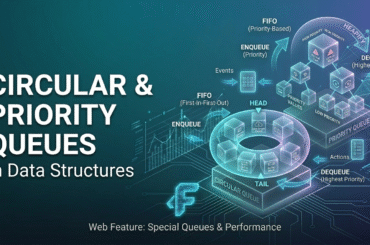
However, a normal queue wastes memory after several deletions. To solve this problem, systems use a Circular Queue.
What is a Circular Queue?
A circular queue connects the last position of the queue back to the first position, forming a circle.
This allows efficient memory usage.
Example queue size:
Operations:
Delete: 2 jobs
Insert: P5, P6
Students must track:
-
Front pointer
-
Rear pointer
Student Tasks
Students must:
-
Explain why circular queue is better than linear queue
-
Simulate operations step-by-step
-
Show front and rear positions
-
Write a C++ program implementing circular queue
Question 04:
Priority Queue (Hospital Emergency System)
Real-World Scenario
In a hospital emergency room, patients are not treated in arrival order. Instead, they are treated based on the severity of their condition.
Example patient list:
| Patient | Priority |
|---|---|
| John | 2 |
| Sara | 5 |
| Ahmed | 1 |
| Ali | 4 |
A higher number indicates higher priority.
So the treatment order becomes:
What is a Priority Queue?
A Priority Queue is a special type of queue where elements are removed based on priority rather than arrival order.
Applications include:
-
Operating system scheduling
-
Emergency services
-
Network packet routing
-
CPU task management
Student Tasks
Students must:
-
Explain how priority queues manage urgent tasks
-
Insert patients into the queue
-
Determine treatment order
-
Write a C++ program implementing a priority queue
Question 05:
Double-Ended Queue (Deque) for Task Scheduling
Real-World Scenario
Modern web servers and operating systems manage tasks based on urgency.
Some tasks must be executed immediately, while others can wait.
For this purpose, systems use a Double-Ended Queue (Deque).
A deque allows insertion and deletion from both ends.
Example Operations
InsertRear(Task2)
InsertFront(Task3)
DeleteRear()
InsertRear(Task4)
Deque state changes during execution.
Why Is Deque Useful?
Deque is widely used in:
-
CPU scheduling
-
Browser history
-
Sliding window algorithms
-
Job scheduling systems
Student Tasks
Students must:
-
Explain the difference between queue and deque
-
Perform given operations
-
Show the state after each step
-
Write a C++ program implementing deque
Submission Requirements for Students
Students must submit the following components:
1. Problem Analysis
Explain the scenario and identify the data structure used.
2. Algorithm
Provide a step-by-step algorithm.
3. Flowchart
Illustrate program logic visually.
4. C++ Implementation
Provide a working C++ program.
5. Output Screenshots
Attach program execution results.
Learning Outcomes of This Assignment
By completing this assignment, students will:
-
Understand real-world applications of linear data structures
-
Improve problem-solving skills
-
Learn how to implement stack and queue structures in C++
-
Understand how data structures are used in software systems
Conclusion
Linear data structures are fundamental building blocks in computer science and software engineering. Through real-world scenarios such as undo operations, calculator expression evaluation, printer scheduling, hospital management systems, and server task management, students gain practical experience applying these structures.
Assignments like this help bridge the gap between theoretical learning and real-world computing problems, preparing students for advanced programming and system design.