Graph Traversal Techniques Explained: BFS and DFS with Real-Time Examples
Introduction
Imagine opening Google Maps and searching for the shortest route to your destination. Or think about how Facebook suggests mutual friends, how web crawlers index websites, or how a maze-solving robot finds its path.
Behind all these intelligent systems lies one important concept in computer science: Graph Traversal.
Graphs are powerful data structures used to represent relationships between objects. To process or analyze these relationships, we need techniques that allow us to visit nodes systematically. Two of the most popular graph traversal techniques are:
- Breadth First Search (BFS)
- Depth First Search (DFS)
These algorithms are fundamental in computer science and are widely used in networking, artificial intelligence, gaming, social media platforms, and navigation systems.
In this blog, you will learn BFS and DFS in a practical, beginner-friendly, and real-world manner.
What is a Graph?
A Graph is a non-linear data structure consisting of:
- Vertices (Nodes) → Represent entities
- Edges → Represent connections between entities
For example:
- Users connected on social media
- Cities connected by roads
- Web pages connected through links
- Computers connected in a network
A graph can be represented as:
G=(V,E)
Where:
- V = Set of vertices
- E = Set of edges
What is Graph Traversal?
Graph Traversal means visiting every node in a graph in a systematic way.
Traversal becomes necessary when we want to:
- Search data
- Find paths
- Analyze networks
- Detect cycles
- Explore relationships
The two major traversal techniques are:
-
Breadth First Search (BFS)
-
Depth First Search (DFS)
Breadth First Search (BFS)
Definition
Breadth First Search (BFS) is a graph traversal algorithm that visits nodes level by level.
It explores all neighboring nodes first before moving deeper into the graph.
Real-Time Example of BFS
Scenario: Finding the Shortest Friend Connection on Social Media
Suppose you want to know how you are connected to another person on LinkedIn or Facebook.
The platform first checks:
- Your direct friends
- Then friends of friends
- Then third-level connections
This level-by-level exploration is exactly how BFS works.
How BFS Works
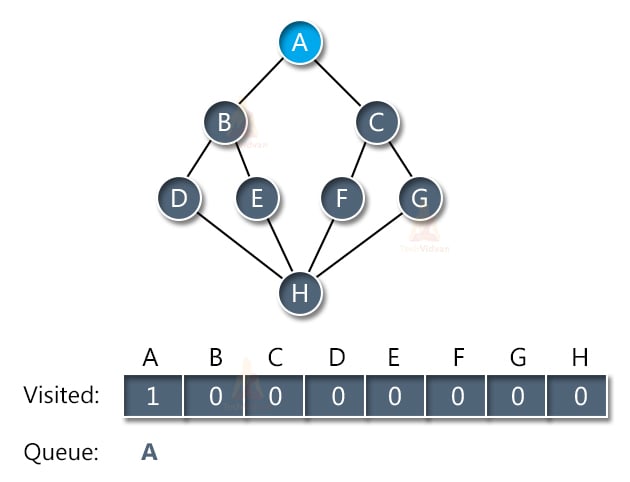
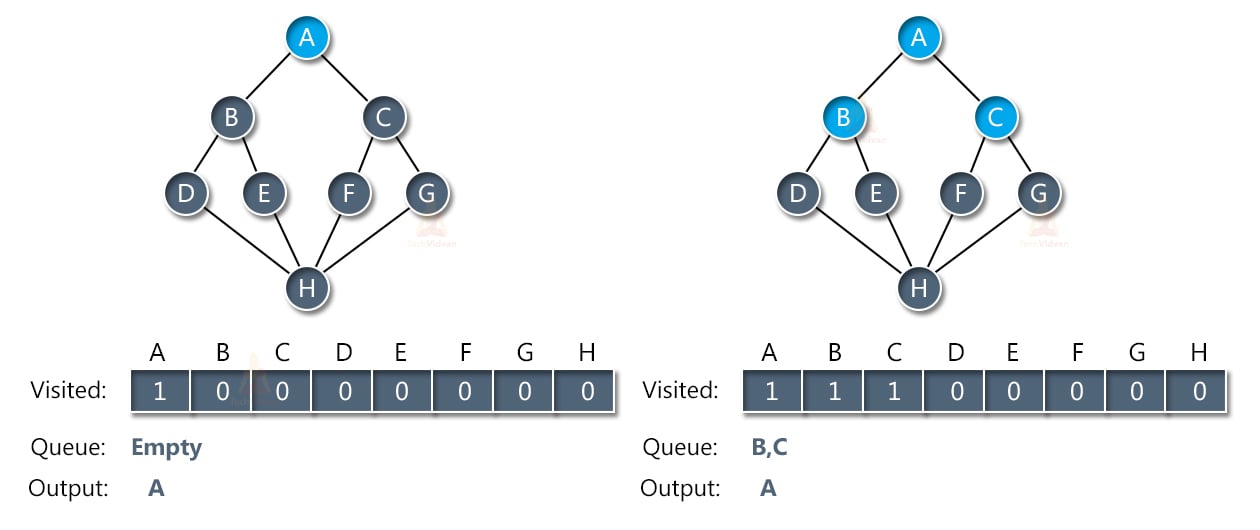
BFS uses a Queue (FIFO) data structure.
Steps of BFS
- Start from a source node
- Mark it as visited
- Insert it into the queue
- Remove a node from the queue
- Visit all unvisited neighbors
- Add neighbors to the queue
- Repeat until the queue becomes empty
BFS Visualization
Consider the graph:
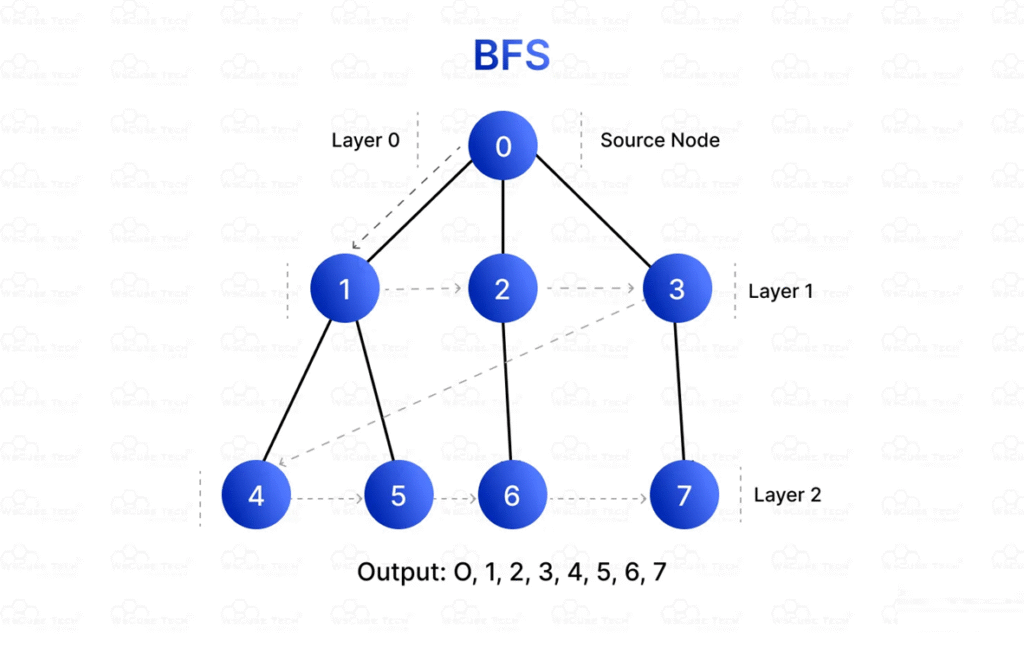
BFS visits nodes level by level.
BFS Algorithm
Pseudocode
BFS(Graph, StartNode)
Create an empty queue
Mark StartNode as visited
Enqueue(StartNode)
While queue is not empty:
Node = Dequeue()
Print Node
For each neighbor of Node:
If neighbor is not visited:
Mark neighbor as visited
Enqueue(neighbor)
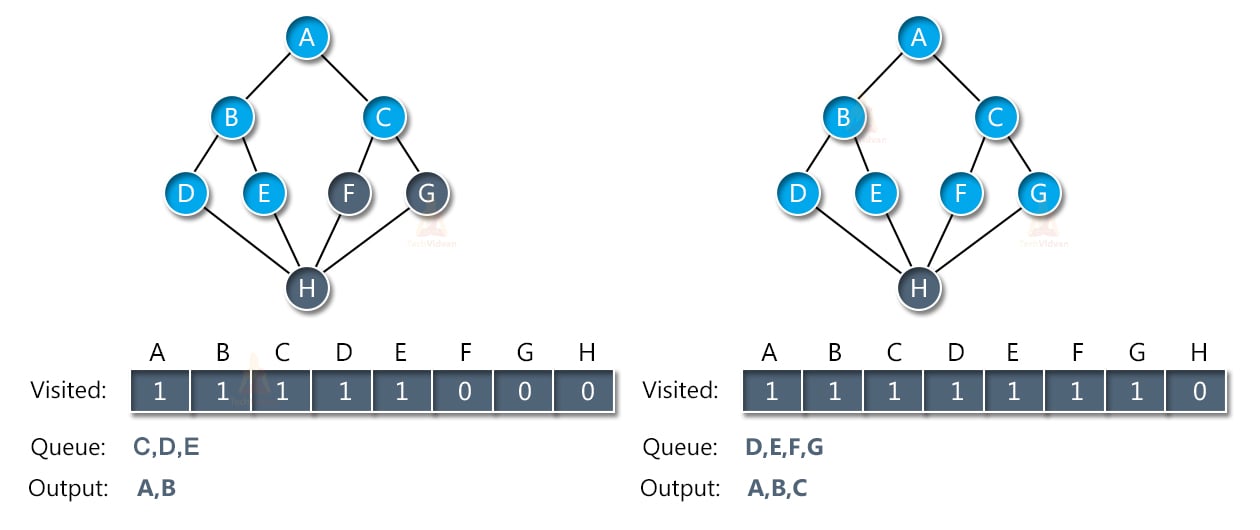
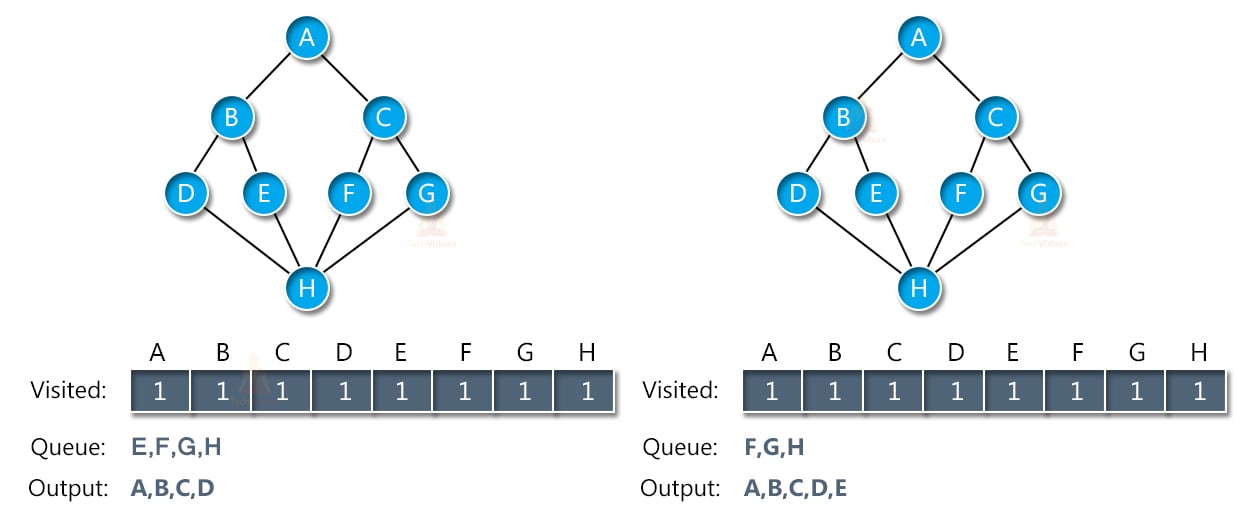
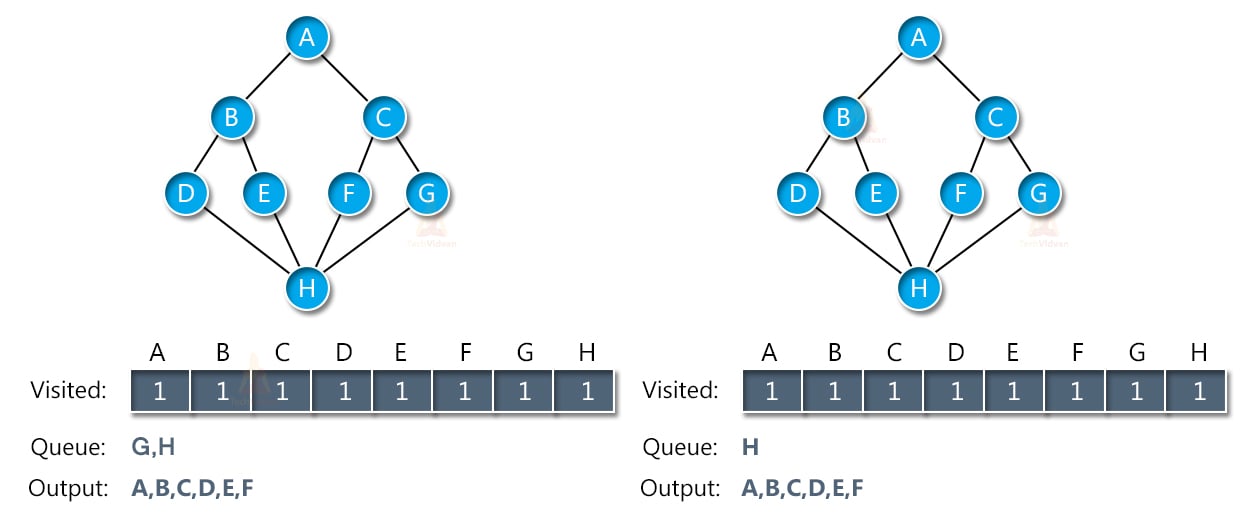
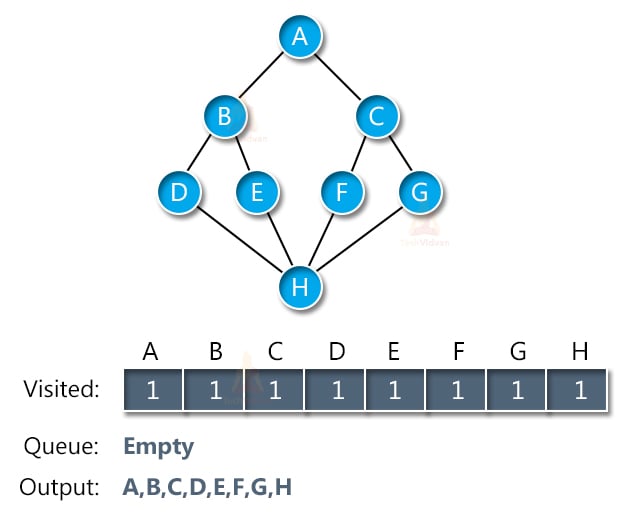
BFS Time Complexity
| Operation | Complexity |
|---|---|
| BFS Traversal | O(V + E) |
Where:
- V = Vertices
- E = Edges
Applications of BFS
1. Shortest Path Finding
Used in GPS and navigation systems.
2. Social Networking
Finding mutual connections and friend suggestions.
3. Web Crawlers
Search engines use BFS-like traversal to index websites.
4. Network Broadcasting
Data packet transmission in networks.
5. AI and Robotics
Pathfinding in games and robotics.
Depth First Search (DFS)
Definition
Depth First Search (DFS) explores a path completely before backtracking.
Instead of visiting neighbors level by level, DFS goes as deep as possible into the graph.
Real-Time Example of DFS
Scenario: Solving a Maze
Imagine entering a maze.
You continue moving forward until you hit a dead end. Then you backtrack and try another path.
This behavior perfectly represents DFS traversal.
How DFS Works
DFS uses:
- Stack
OR - Recursion
Steps of DFS
- Start from a source node
- Mark it as visited
- Visit one unvisited neighbor deeply
- Continue until no neighbor remains
- Backtrack to previous nodes
- Repeat until all nodes are visited
DFS Visualization
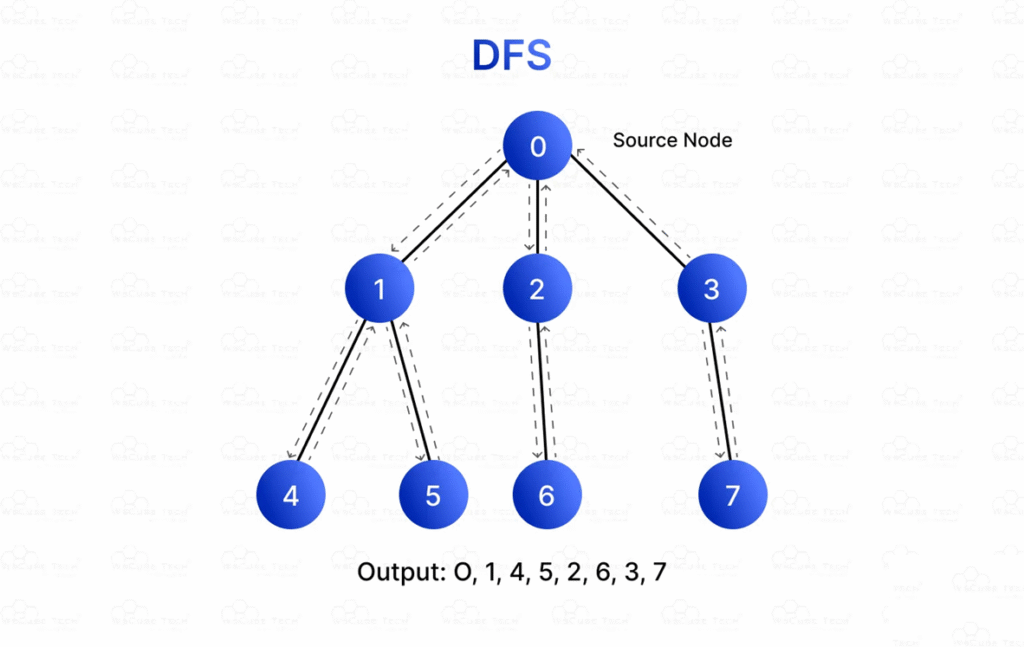
DFS explores depth before breadth.
DFS Algorithm
Pseudocode
DFS(Graph, Node)
Mark Node as visited
Print Node
For each neighbor of Node:
If neighbor is not visited:
DFS(Graph, neighbor)
-copy-660.webp)
-copy-660.webp)
-copy-660.webp)
-copy-660.webp)
-copy-660.webp)
DFS Time Complexity
| Operation | Complexity |
|---|---|
| DFS Traversal | O(V + E) |
Applications of DFS
1. Maze Solving
Used in puzzle-solving systems.
2. Cycle Detection
Detecting loops in graphs.
3. Topological Sorting
Used in task scheduling systems.
4. File System Traversal
Exploring directories and subdirectories.
5. Artificial Intelligence
Game decision trees and search problems.
BFS vs DFS Comparison
| Feature | BFS | DFS |
|---|---|---|
| Traversal Style | Level by Level | Depth Wise |
| Data Structure | Queue | Stack |
| Shortest Path | Yes | Not Guaranteed |
| Memory Usage | Higher | Lower |
| Backtracking | No | Yes |
| Suitable For | Shortest Path | Deep Exploration |
Practical Example in Daily Life
BFS Example: Delivery Routing
A food delivery company wants to find the nearest delivery point first. BFS helps explore nearby locations level by level.
DFS Example: File Searching
Suppose your computer searches files inside folders and subfolders deeply before returning. This behavior follows DFS.
Common Interview Questions
1. What is the difference between BFS and DFS?
BFS explores level by level while DFS explores depth first.
2. Which traversal is better for shortest path?
BFS is better because it guarantees the shortest path in unweighted graphs.
3. Which data structure is used in DFS?
Stack or recursion.
4. What is the time complexity of BFS and DFS?
Both have:
O(V+E)
Advantages of BFS
- Finds shortest path
- Easy to implement
- Useful in networking
Disadvantages of BFS
- Uses more memory
- Slower for deep graphs
Advantages of DFS
- Requires less memory
- Good for deep searches
- Useful for backtracking problems
Disadvantages of DFS
- Does not guarantee shortest path
- Can get trapped in deep paths
Conclusion
Graph traversal techniques are the backbone of many modern computing systems. Whether it is social media suggestions, navigation systems, robotics, gaming, or artificial intelligence, BFS and DFS play a vital role in solving complex problems efficiently.
- Breadth First Search (BFS) is ideal for shortest path and level-wise exploration.
- Depth First Search (DFS) is perfect for deep searching and recursive exploration.
Understanding these algorithms helps students and developers build strong foundations in data structures and algorithms.
If you are learning programming, mastering BFS and DFS is an essential step toward becoming an efficient problem solver.