Binary Search Tree (BST): Complete Guide with Implementation, Traversals & Searching
Table of Contents
- Introduction to Binary Search Tree (BST)
- Objective of the Lab
- Learning Outcomes
- What is a Binary Search Tree?
- Properties of BST
- BST vs Binary Tree
- Structure of a BST Node
- BST Operations
- Insertion
- Searching
- BST Traversal Algorithms
- PreOrder Traversal
- InOrder Traversal
- PostOrder Traversal
- Real-World Example of BST
- Time Complexity Analysis
- Advantages & Disadvantages
- Conclusion
- FAQs
1. Introduction to Binary Search Tree (BST)
A Binary Search Tree (BST) is one of the most important data structures in computer science, widely used for efficient searching, sorting, and data organization.
It is a specialized form of a Binary Tree that follows a specific ordering rule, making operations faster and more optimized.
2. Objective of the Lab
The main objective of this lab is to:
- Understand the concept of Binary Search Tree (BST)
- Learn how to implement BST using programming
- Perform traversal operations
- Implement efficient searching techniques
3. Learning Outcomes
After completing this lab, students will be able to:
- Code a BST as a special case of a Binary Tree
- Implement traversal techniques:
- PreOrder
- InOrder
- PostOrder
- Perform efficient searching in BST
. What is a Binary Search Tree?
A Binary Search Tree (BST) is a binary tree where each node follows this rule:
- Left subtree contains values smaller than the node
- Right subtree contains values greater than the node
5. Properties of BST
- Each node has at most two children
- Left child < Parent < Right child
- No duplicate values (in standard BST)
- InOrder traversal always gives sorted output
6. BST vs Binary Tree
| Feature | Binary Tree | Binary Search Tree |
|---|---|---|
| Structure | Any arrangement | Ordered structure |
| Searching | O(n) | O(log n) (average) |
| Traversal | Not sorted | InOrder is sorted |
7. Structure of a BST Node
struct Node {
   int data;
   Node* left;
   Node* right;
};
8. BST Operations
A. Insertion in BST
Node* insert(Node* root, int value) {
    if (root == NULL) {
        return new Node{value, NULL, NULL};
    }

    if (value < root->data)
        root->left = insert(root->left, value);
    else if (value > root->data)
        root->right = insert(root->right, value);

    return root;
}
B. Searching in BST
Searching is efficient because of the ordered structure.
bool search(Node* root, int key) {
    if (root == NULL) return false;

    if (root->data == key)
        return true;
    else if (key < root->data)
        return search(root->left, key);
    else
        return search(root->right, key);
}
COMPLETE CODE:
#include <iostream>
using namespace std;

// Node structure
struct Node {
   int data;
   Node* left;
   Node* right;

Node(int value) {
    data = value;
    left = right = NULL;
}
};

// Insert function
Node* insert(Node* root, int value) {
    if (root == NULL) {
        return new Node(value);
    }

    if (value < root->data) {
        root->left = insert(root->left, value);
    }
    else if (value > root->data) {
        root->right = insert(root->right, value);
    }

    return root;
}

// Search function
bool search(Node* root, int key) {
    if (root == NULL) {
        return false;
    }

    if (root->data == key) {
        return true;
    }
    else if (key < root->data) {
        return search(root->left, key);
    }
    else {
        return search(root->right, key);
    }
}

// InOrder Traversal (for testing - prints sorted values)
void inorder(Node* root) {
    if (root == NULL) return;

    inorder(root->left);
    cout << root->data << " ";
    inorder(root->right);
}

// Main function
int main() {
    Node* root = NULL;

    // Inserting values into BST
    root = insert(root, 50);
    insert(root, 30);
    insert(root, 70);
    insert(root, 20);
    insert(root, 40);
    insert(root, 60);
    insert(root, 80);

    // Display BST (InOrder Traversal)
    cout << "BST InOrder Traversal (Sorted): ";
    inorder(root);
    cout << endl;

    // Searching values
    int key;
    cout << "Enter value to search: ";
    cin >> key;

    if (search(root, key)) {
        cout << "Value found in BST." << endl;
    } else {
        cout << "Value NOT found in BST." << endl;
    }

    return 0;
}
Output:
BST InOrder Traversal (Sorted): 20 30 40 50 60 70 80
Enter value to search: 60
Value found in BST.
9. BST Traversal Algorithms
Traversal means visiting nodes in a specific order.
1. PreOrder Traversal (Root → Left → Right)
void preorder(Node* root) {
    if (root == NULL) return;
    cout << root->data << " ";
    preorder(root->left);
    preorder(root->right);
}
2. InOrder Traversal (Left → Root → Right)
👉 Key Insight: In BST, InOrder traversal gives sorted data
void inorder(Node* root) {
    if (root == NULL) return;
    inorder(root->left);
    cout << root->data << " ";
    inorder(root->right);
}
3. PostOrder Traversal (Left → Right → Root)
void postorder(Node* root) {
    if (root == NULL) return;
    postorder(root->left);
    postorder(root->right);
    cout << root->data << " ";
}
Complete BST Traversal Code (C++)
#include <iostream>
using namespace std;

// Node structure
struct Node {
    int data;
    Node* left;
    Node* right;

Node(int value) {
    data = value;
    left = right = NULL;
}
};

// Insert function to build BST
Node* insert(Node* root, int value) {
    if (root == NULL) {
        return new Node(value);
    }

    if (value < root->data)
        root->left = insert(root->left, value);
    else if (value > root->data)
        root->right = insert(root->right, value);

    return root;
}

// PreOrder Traversal (Root → Left → Right)
void preorder(Node* root) {
    if (root == NULL) return;

    cout << root->data << " ";
    preorder(root->left);
    preorder(root->right);
}

// InOrder Traversal (Left → Root → Right)
void inorder(Node* root) {
    if (root == NULL) return;

    inorder(root->left);
    cout << root->data << " ";
    inorder(root->right);
}

// PostOrder Traversal (Left → Right → Root)
void postorder(Node* root) {
    if (root == NULL) return;

    postorder(root->left);
    postorder(root->right);
    cout << root->data << " ";
}

// Main function
int main() {
    Node* root = NULL;

    // Insert values into BST
    root = insert(root, 50);
    insert(root, 30);
    insert(root, 70);
    insert(root, 20);
    insert(root, 40);
    insert(root, 60);
    insert(root, 80);

    // Traversals
    cout << "PreOrder Traversal: ";
    preorder(root);
    cout << endl;

    cout << "InOrder Traversal: ";
    inorder(root);
    cout << endl;

    cout << "PostOrder Traversal: ";
    postorder(root);
    cout << endl;

    return 0;
}
10. Real-World Example of BST
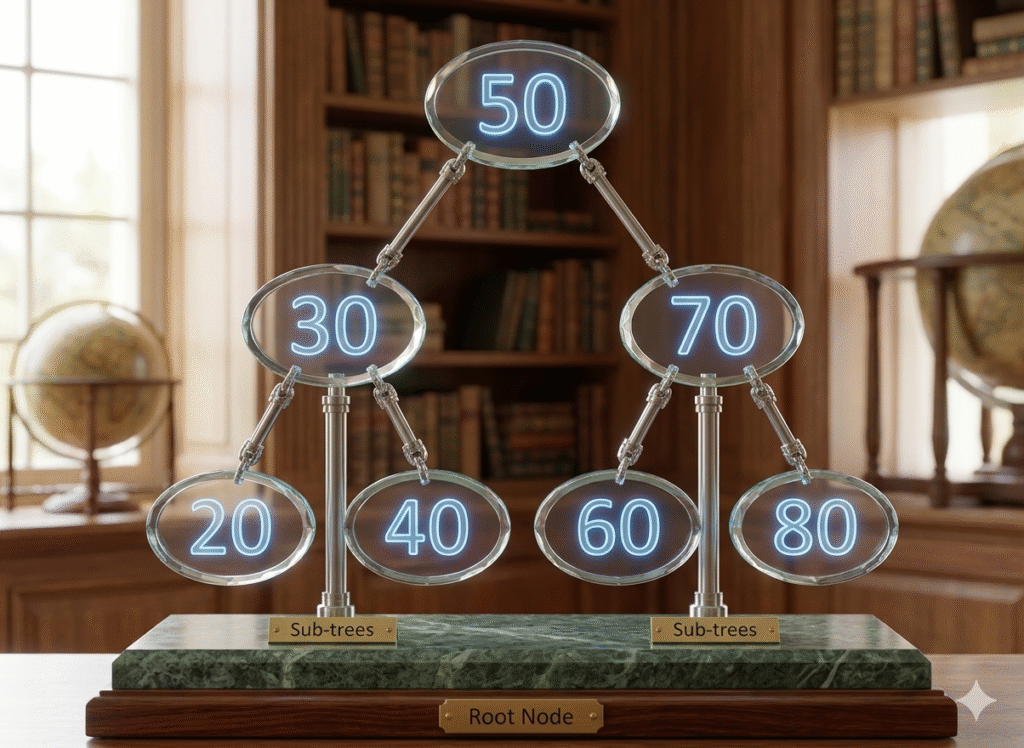
Library Management System
Imagine a digital library system where books are stored using ISBN numbers.
- Each book is inserted into the BST
- Searching a book becomes fast using BST rules
Example Flow:
- Insert books: 50, 30, 70, 20, 40
- Search for book with ISBN 40
- Compare with root (50) → go left
- Compare with 30 → go right
- Found at 40
Why BST?
- Fast lookup
- Organized storage
- Efficient updates
11. Time Complexity Analysis
| Operation | Average Case | Worst Case |
|---|---|---|
| Insertion | O(log n) | O(n) |
| Searching | O(log n) | O(n) |
| Traversal | O(n) | O(n) |
👉 Worst case occurs when BST becomes skewed (like a linked list)
12. Advantages & Disadvantages
✅ Advantages:
- Efficient searching and insertion
- Maintains sorted data
- Easy to implement
❌ Disadvantages:
- Can become unbalanced
- Performance degrades in worst case
- Requires extra memory for pointers
Activity 01:
Iterative BST Insertion Code (C++)
#include <iostream>
using namespace std;

// Node structure
struct Node {
   int data;
   Node* left;
   Node* right;

Node(int value) {
    data = value;
    left = right = NULL;
}
};

// Iterative Insert Function
Node* insertIterative(Node* root, int value) {
    Node* newNode = new Node(value);

    // If tree is empty
    if (root == NULL) {
        return newNode;
    }

    Node* current = root;
    Node* parent = NULL;

    while (current != NULL) {
        parent = current;

        if (value < current->data) {
            current = current->left;
        }
        else if (value > current->data) {
            current = current->right;
        }
        else {
            // Duplicate values not allowed
            return root;
        }
    }

    // Attach new node to the correct parent
    if (value < parent->data) {
        parent->left = newNode;
    } else {
        parent->right = newNode;
    }

    return root;
}

// InOrder Traversal (to verify BST)
void inorder(Node* root) {
    if (root == NULL) return;

    inorder(root->left);
    cout << root->data << " ";
    inorder(root->right);
}

// Main function
int main() {
    Node* root = NULL;

    // Iterative Insertions
    root = insertIterative(root, 50);
    insertIterative(root, 30);
    insertIterative(root, 70);
    insertIterative(root, 20);
    insertIterative(root, 40);
    insertIterative(root, 60);
    insertIterative(root, 80);

    // Display tree
    cout << "InOrder Traversal (Sorted): ";
    inorder(root);
    cout << endl;

    return 0;
}
Output:
InOrder Traversal (Sorted): 20 30 40 50 60 70 80
Activity 02:
BST Traversals Code (PreOrder, InOrder, PostOrder)
#include <iostream>
using namespace std;

// Node structure
struct Node {
   int data;
   Node* left;
   Node* right;

Node(int value) {
    data = value;
    left = right = NULL;
}
};

// Iterative Insertion
Node* insertIterative(Node* root, int value) {
    Node* newNode = new Node(value);

    if (root == NULL) {
        return newNode;
    }

    Node* current = root;
    Node* parent = NULL;

    while (current != NULL) {
        parent = current;

        if (value < current->data)
            current = current->left;
        else if (value > current->data)
            current = current->right;
        else
            return root; // no duplicates
    }

    if (value < parent->data)
        parent->left = newNode;
    else
        parent->right = newNode;

    return root;
}

// PreOrder Traversal (Root → Left → Right)
void preorder(Node* root) {
    if (root == NULL) return;

    cout << root->data << " ";
    preorder(root->left);
    preorder(root->right);
}

// InOrder Traversal (Left → Root → Right)
void inorder(Node* root) {
    if (root == NULL) return;

    inorder(root->left);
    cout << root->data << " ";
    inorder(root->right);
}

// PostOrder Traversal (Left → Right → Root)
void postorder(Node* root) {
    if (root == NULL) return;

    postorder(root->left);
    postorder(root->right);
    cout << root->data << " ";
}

// Main Function
int main() {
    Node* root = NULL;

    // Insert values
    root = insertIterative(root, 50);
    insertIterative(root, 30);
    insertIterative(root, 70);
    insertIterative(root, 20);
    insertIterative(root, 40);
    insertIterative(root, 60);
    insertIterative(root, 80);

    // Traversals
    cout << "PreOrder Traversal: ";
    preorder(root);
    cout << endl;

    cout << "InOrder Traversal: ";
    inorder(root);
    cout << endl;

    cout << "PostOrder Traversal: ";
    postorder(root);
    cout << endl;

    return 0;
}
Output:
PreOrder Traversal: 50 30 20 40 70 60 80
InOrder Traversal: 20 30 40 50 60 70 80
PostOrder Traversal: 20 40 30 60 80 70 50
Activity 03:
Write down the search method for BST.
1. Recursive Search Method in BST
bool search(Node* root, int key) {
    // Base case: empty tree or value found
    if (root == NULL)
        return false;

    if (root->data == key)
        return true;

    // Search in left subtree
    if (key < root->data)
        return search(root->left, key);

    // Search in right subtree
    return search(root->right, key);
}
2. Iterative Search Method in BST
bool searchIterative(Node* root, int key) {
    Node* current = root;

    while (current != NULL) {
        if (current->data == key)
            return true;
        else if (key < current->data)
            current = current->left;
        else
            current = current->right;
    }

    return false; // Not found
}
Activity 04:
Write down the method to count to number of nodes and find the sum of all nodes
#include <iostream>
using namespace std;

struct Node {
   int data;
   Node* left;
   Node* right;

Node(int value) {
    data = value;
    left = right = NULL;
}
};

Node* insert(Node* root, int value) {
    if (root == NULL)
        return new Node(value);

    if (value < root->data)
        root->left = insert(root->left, value);
    else if (value > root->data)
        root->right = insert(root->right, value);

    return root;
}

int countNodes(Node* root) {
    if (root == NULL)
        return 0;

    return 1 + countNodes(root->left) + countNodes(root->right);
}

int sumNodes(Node* root) {
    if (root == NULL)
        return 0;

    return root->data + sumNodes(root->left) + sumNodes(root->right);
}

int main() {
    Node* root = NULL;

    // Insert values
    root = insert(root, 50);
    insert(root, 30);
    insert(root, 70);
    insert(root, 20);
    insert(root, 40);
    insert(root, 60);
    insert(root, 80);

    cout << "Total Nodes: " << countNodes(root) << endl;
    cout << "Sum of Nodes: " << sumNodes(root) << endl;

    return 0;
}
Output:
Total Nodes: 7
Sum of Nodes: 350
3) Graded Lab Tasks
Lab Task 1
Implement the methods for Tree Traversal with Right Branch Priority i.e. Pre Order (NRL), Post Order (RLN) and In Order (RNL).
Lab Task 2
Write down code to print and count Leaf nodes of a BST.
Lab Task 3
Introduce method to delete a Node from BST, keep in mind that there are 3 possiblities for deletion, Node without any child, Node with One child and Node with both the children.
13. Conclusion
A Binary Search Tree (BST) is a powerful data structure that significantly improves search efficiency compared to linear structures.
By mastering:
- BST implementation
- Traversal algorithms
- Searching techniques
you build a strong foundation for advanced topics like:
- AVL Trees
- Red-Black Trees
- Heaps
14. FAQs
Q1: Why is BST faster than a normal binary tree?
Because it follows an ordered structure that reduces search space.
Q2: What traversal gives sorted output?
InOrder traversal
Q3: What is the biggest drawback of BST?
It can become unbalanced, leading to O(n) complexity.