Why is DSA important for technical interviews?
Recruiters are not only testing your ability to memorize the DSA questions, but also to problem-solve, think logically, and code efficiently. A candidate who can answer the following question and explain why a hash map is better than linear search or when to use a heap instead of a sorted array is ready for actual engineering work. Hence, DSA is present throughout all the stages of the screening process, even in the rounds of senior-level system design.
Computer Science and Software Engineering is built upon Data Structures and Algorithms (DSA). The concepts of DSA are assessed in every technical interview across the business domains of Software Development, Data Engineering, AI, Cyber Security and Competitive Programming. Firms want to see candidates not just know the theory but also be able to solve a real-world programming problem in an effective way.
Cracking a technical interview in a product-based company exclusively depends on one thing – the depth of your knowledge of Data Structures and Algorithms (DSA). This guide includes the best 40 DSA Interview Questions and Answers 2026 along with explanations and concepts, grouped by difficulty and ready to be coded.
This is no dictionary of definitions. Every response is presented as the interviewer would expect, short and to the point, correct technically, and supported by a time/space complexity argument.
The book provides a detailed answer to the most common questions asked in data structures and algorithms interviews for beginner, intermediate and advanced levels.
Object-Oriented Programming Interview Questions
1. What is a Data Structure?
A Data Structure is a special way of arranging and storing data in a manner that makes it easy to access, manipulate, and compute.
The following are examples of common data structures:
- Arrays
- Linked Lists
- Stacks
- Queues
- Trees
- Graphs
- Hash Tables
- Heaps
Depending on the operations that are needed, different data structures are appropriate for different applications.
Top OOP Interview Questions and Answers for Freshers in 2026 | Complete Guide
2. Explain the meaning of the word Algorithm?
An algorithm is a finite sequence of well-defined instructions that solves a particular problem or carries out a computation.
An efficient algorithm should have:
- Clearly defined inputs
- Clearly defined outputs
- Definiteness
- Finiteness
- Effectiveness
3. What is the Difference Between Data Structures and Algorithms?
| Data Structure | Algorithm |
|---|---|
| Organizes data | Solves problems |
| Focuses on storage | Focuses on processing |
| Improves data access | Improves execution efficiency |
| Examples: Stack, Queue | Examples: Binary Search, Merge Sort |
4. What is Time Complexity?
Time complexity is the time taken by an algorithm to run as the input size increases.
Common complexities include:
| Complexity | Performance |
|---|---|
| O(1) | Constant |
| O(log n) | Logarithmic |
| O(n) | Linear |
| O(n log n) | Linear Logarithmic |
| O(n²) | Quadratic |
| O(2ⁿ) | Exponential |
5. What is Space Complexity?
Space Complexity refers to the total amount of memory required by an algorithm during execution.
It includes:
- Input storage
- Auxiliary memory
- Variables
- Recursive stack memory
6. What is Big O Notation?
Big O Notation describes the worst-case performance of an algorithm.
Examples:
- Accessing an array element → O(1)
- Linear Search → O(n)
- Binary Search → O(log n)
- Merge Sort → O(n log n)
7. What is an Array?
Answer:
An Array is a collection of elements stored in contiguous memory locations.
Advantages
- Fast random access
- Easy implementation
Disadvantages
- Fixed size
- Expensive insertion and deletion
8. What is a Linked List?
Answer:
A Linked List is a linear data structure where each node contains the following:
- Data
- Pointer to the next node
Types include:
- Singly Linked List
- Doubly Linked List
- Circular Linked List
9. Difference Between Array and Linked List
| Array | Linked List |
|---|---|
| Contiguous memory | Non-contiguous memory |
| Fixed size | Dynamic size |
| Fast indexing | Sequential access |
| Slow insertion | Fast insertion |
10. What is a Stack?
A Stack is a linear data structure that follows the LIFO (Last In, First Out) principle.
Operations include:
- Push
- Pop
- Peek
- IsEmpty
Applications:
- Function calls
- Expression evaluation
- Undo operations
11. What is a Queue?
A Queue follows the FIFO (First In, First Out) principle.
Operations:
- Enqueue
- Dequeue
- Front
- Rear
Applications:
- CPU scheduling
- Printer queue
- Task scheduling
12. Difference Between Stack and Queue
| Stack | Queue |
|---|---|
| LIFO | FIFO |
| Push/Pop | Enqueue/Dequeue |
| One end | Two ends |
13. What is a Tree?
A Tree is a hierarchical data structure consisting of nodes connected by edges.
Terminology:
- Root
- Parent
- Child
- Leaf
- Height
- Depth
14. What is a Binary Tree?
A Binary Tree is a tree where each node has at most two children:
- Left Child
- Right Child
Applications:
- Expression trees
- Parsing
- Hierarchical representation
15. What is a Binary Search Tree (BST)?
A binary search tree satisfies the following:
- Left subtree contains smaller values
- Right subtree contains larger values
Average operations:
- Search → O(log n)
- Insert → O(log n)
- Delete → O(log n)
16. What is Tree Traversal?
Tree traversal means visiting every node exactly once.
Methods:
Inorder
Left → Root → Right
Preorder
Root → Left → Right
Postorder
Left → Right → Root
Level Order
Breadth First Search (BFS)
17. What is a Graph?
A Graph consists of:
- Vertices (Nodes)
- Edges
Types:
- Directed Graph
- Undirected Graph
- Weighted Graph
- Cyclic Graph
- Acyclic Graph
Applications:
- Social networks
- GPS navigation
- Network routing
18. What is BFS?
Breadth First Search (BFS) explores nodes level by level using a queue.
Time Complexity: O(V + E)
Applications:
- Shortest path
- Level traversal
- Network broadcasting
19. What is DFS?
Depth First Search (DFS) explores one branch completely before backtracking.
Uses:
- Cycle detection
- Topological sorting
- Maze solving
Time Complexity: O(V + E)
20. What is a Hash Table?
A hash table stores key-value pairs using a hash function.
Advantages:
- Average search → O(1)
- Average insertion → O(1)
Collision handling methods:
- Chaining
- Open Addressing
21. What is Collision in Hashing?
A collision occurs when two different keys generate the same hash value.
Solutions:
- Separate Chaining
- Linear Probing
- Quadratic Probing
- Double Hashing
22. What is Recursion?
Recursion is a programming technique where a function calls itself until a base condition is reached.
Examples:
- Factorial
- Fibonacci
- Tree traversal
23. What is Dynamic Programming?
Dynamic Programming solves complex problems by breaking them into smaller overlapping subproblems and storing intermediate results.
Techniques:
- Memoization
- Tabulation
Examples:
- Fibonacci
- Knapsack
- Longest Common Subsequence
24. What is Greedy Algorithm?
A Greedy Algorithm selects the locally optimal solution at every step.
Examples:
- Prim’s Algorithm
- Kruskal’s Algorithm
- Huffman Coding
- Dijkstra’s Algorithm
25. What is Divide and Conquer?
Divide and Conquer divides a problem into smaller independent subproblems, solves them recursively, and combines their solutions.
Examples:
- Merge Sort
- Quick Sort
- Binary Search
26. Difference Between Merge Sort and Quick Sort
| Merge Sort | Quick Sort |
|---|---|
| Stable | Not stable |
| O(n log n) worst case | O(n²) worst case |
| Extra memory required | In-place sorting |
| Suitable for linked lists | Faster for arrays |
27. What is Binary Search?
Binary Search searches a sorted array by repeatedly dividing the search interval into halves.
Requirements:
- Sorted array
Time Complexity: O(log n)
28. What is Linear Search?
Linear Search checks every element sequentially.
Time Complexity:
- Best Case → O(1)
- Worst Case → O(n)
29. Difference Between BFS and DFS
| BFS | DFS |
|---|---|
| Queue | Stack/Recursion |
| Level-wise | Depth-wise |
| Finds shortest path | Does not guarantee shortest path |
| Higher memory | Lower memory |
30. Explain Heap Data Structure
A Heap is a complete binary tree.
Types:
Max Heap
Parent ≥ Children
Min Heap
Parent ≤ Children
Applications:
- Priority Queue
- Heap Sort
- Scheduling
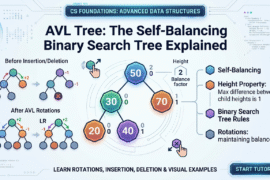
31. What is AVL Tree?
AVL Tree is a binary search tree that is balanced at most 1 level.
Advantages:
- Faster searching
- Balanced structure
- O(log n) operations
32. What is Red-Black Tree?
A Red-Black Tree is a self-balancing Binary Search Tree with color properties that maintain balance during insertions and deletions.
Applications:
- C++ STL Map
- Java TreeMap
- Database indexing
33. What is a Trie?
A Trie is a tree-based data structure used to store and search strings efficiently.
Applications:
- Auto-complete
- Spell checking
- Dictionary implementations
34. What is Topological Sorting?
Topological Sorting arranges the vertices of a Directed Acyclic Graph (DAG) so that every directed edge points from an earlier vertex to a later vertex in the ordering.
Applications:
- Task scheduling
- Dependency resolution
- Course prerequisite planning
35. What is Dijkstra’s Algorithm?
Dijkstra’s Algorithm finds the shortest path from a source node to all other nodes in a weighted graph with non-negative edge weights.
Time Complexity:
- O(V²) using arrays
- O((V + E) log V) using a priority queue
Applications:
- GPS navigation
- Network routing
- Logistics optimization
36. What is Kruskal’s Algorithm?
Kruskal’s Algorithm finds the Minimum Spanning Tree (MST) of a connected, weighted graph by selecting the smallest edge that does not create a cycle.
Time Complexity: O(E log E)
Applications:
- Network design
- Road construction
- Telecommunications
37. What is Prim’s Algorithm?
Prim’s Algorithm constructs a Minimum Spanning Tree by starting from any vertex and repeatedly adding the minimum-weight edge connecting the tree to a new vertex.
Time Complexity: O((V + E) log V) using a priority queue.
38. What are Stable and Unstable Sorting Algorithms?
A Stable Sorting Algorithm preserves the relative order of equal elements, while an Unstable Sorting Algorithm may change their order.
Stable Sorting Algorithms:
- Merge Sort
- Bubble Sort
- Insertion Sort
Unstable Sorting Algorithms:
- Quick Sort
- Heap Sort
- Selection Sort
39. What is the Difference Between Memoization and Tabulation?
| Memoization | Tabulation |
|---|---|
| Top-down approach | Bottom-up approach |
| Uses recursion | Uses iteration |
| Computes only required states | Computes all states |
| May use recursion stack | No recursion stack |
40. What Are the Best Tips for Cracking a DSA Interview?
To excel in a Data Structures and Algorithms interview:
- Master the fundamentals of arrays, linked lists, stacks, queues, trees, graphs, heaps, and hash tables.
- Practice analyzing time and space complexity for every solution.
- Learn common algorithmic paradigms such as divide and conquer, dynamic programming, greedy algorithms, and backtracking.
- Solve coding problems regularly on platforms like LeetCode, HackerRank, and Codeforces.
- Practice writing clean, optimized, and readable code.
- Clearly explain your thought process and justify your approach during interviews.
- Review common sorting and searching algorithms along with their complexities.
- Prepare for both theoretical questions and hands-on coding challenges.
Conclusion
A strong understanding of Data Structures and Algorithms is essential for succeeding in technical interviews at leading software companies. By mastering core concepts such as arrays, linked lists, stacks, queues, trees, graphs, hashing, recursion, dynamic programming, sorting, searching, and graph algorithms, candidates can confidently tackle interview questions and design efficient solutions. Consistent practice, complexity analysis, and effective communication of problem-solving strategies significantly improve interview performance and help build a solid foundation for a successful software engineering career.
You may visit LeetCode to test your preparation.
Ready to elevate your career? Join our technical community and read our latest Tech Interview Preparation Blogs. We cover everything from Data Structures and Algorithms to system design, coding tutorials, and industry best practices to help you succeed.