
Infix to Postfix Conversion Using Stack
Infix Expression:
An expression in which operators are written between operands, e.g.,
A + B * C
Postfix Expression (Reverse Polish Notation):
An expression in which operators come after operands, e.g.,
A B C * +

Why convert infix to postfix?
-
Postfix expressions do not require parentheses
-
They are easier to evaluate using a stack
-
Widely used in compiler design and calculators
Have you practiced the last lesson? Introduction to Stack in C++
🔹 Real-World Use Case
-
Evaluators in calculators: Convert
2 + 3 * 4→2 3 4 * +to compute efficiently -
Compiler parsing: Translating mathematical expressions into a machine-friendly format
-
Expression evaluation in programming
🔹 Algorithm for Infix to Postfix Conversion
-
Initialize an empty stack for operators.
-
Scan the infix expression from left to right:
-
If operand, add to postfix expression.
-
If ‘(’, push to stack.
-
If ‘)’, pop from stack to postfix until ‘(’ is found.
-
If operator, pop operators with higher or equal precedence from stack to postfix, then push current operator.
-
-
Pop any remaining operators from the stack to postfix.
Operator Precedence (Highest → Lowest):
^ > * / > + –
| Infix | Postfix |
|---|---|
| A + B | AB+ |
| A + B * C | ABC*+ |
| (A + B) * C | AB+C* |
Operator Precedence
| Operator | Priority |
|---|---|
^ |
Highest |
* / |
High |
+ - |
Low |
( |
Special |
Stack Rules for Conversion
-
Scan the expression from left to right
-
If operand → add to postfix expression
-
If ‘(‘ → push to stack
-
If ‘)’ → pop from stack until
'('is removed -
If operator:
-
Pop operators from stack while precedence ≥ current operator
-
Push current operator
-
-
After scanning completes → pop remaining operators from stack
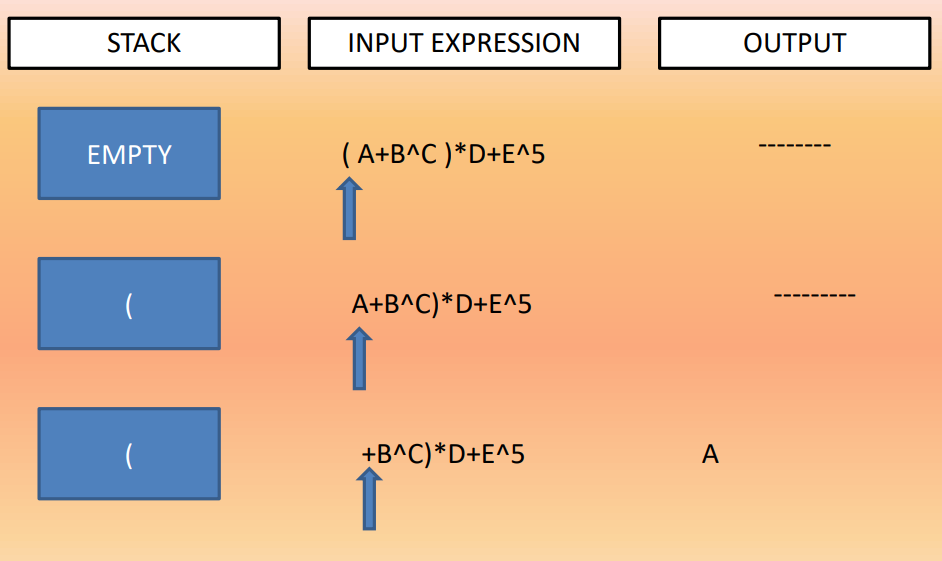
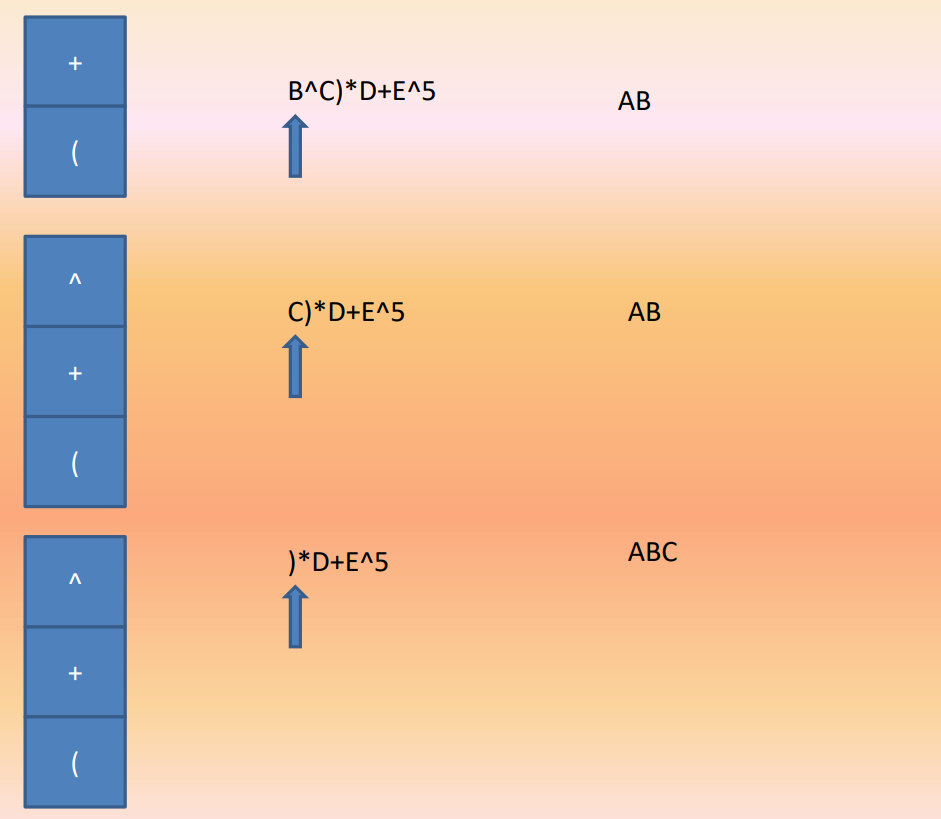
Example with Step-by-Step Diagram
Convert: (A + B) * C
Step-by-step:
| Symbol | Stack | Output |
|---|---|---|
| ( | ( | |
| A | ( | A |
| + | ( + | A |
| B | ( + | AB |
| ) | AB+ | |
| * | * | AB+ |
| C | * | AB+C |
| End | AB+C* |
Stack Visualization
Input: (A+B)*C
Step 1 Stack: (
Step 2 Output: A
Step 3 Stack: ( +
Step 4 Output: AB
Step 5 Output: AB+
Step 6 Stack: *
Step 7 Output: AB+C
Final Output: AB+C*
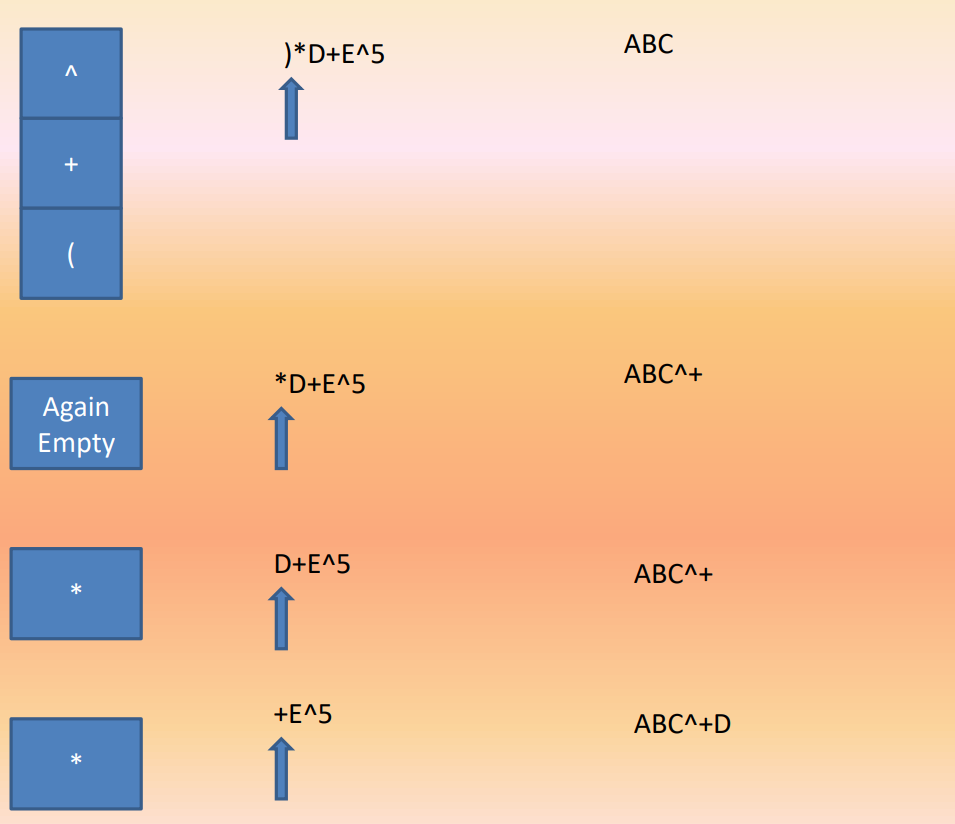
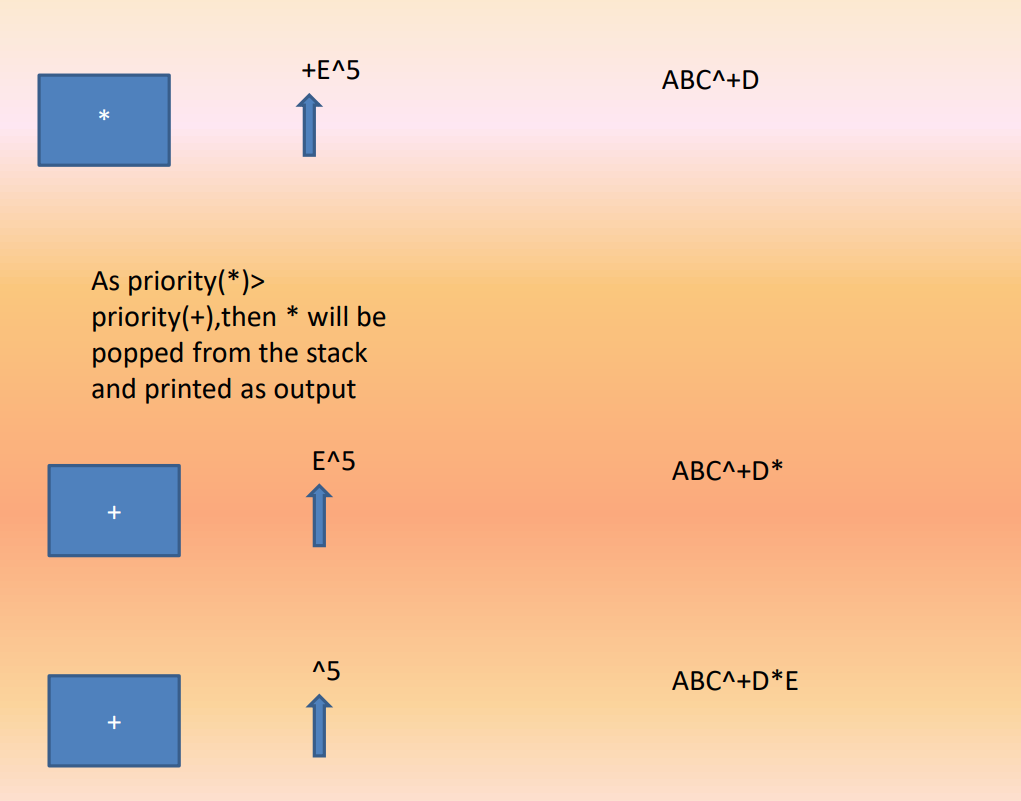
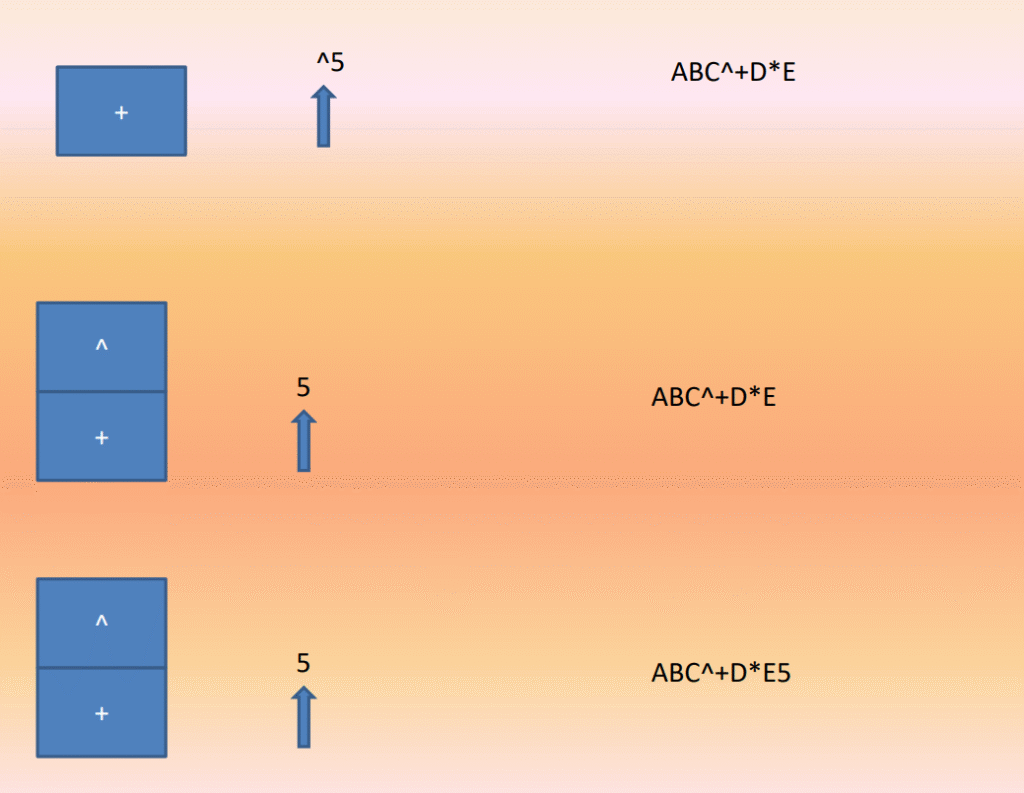
Algorithm (Simple Form)
1. Create empty stack
2. For each character in expression:
if operand → add to output
if ‘(‘ → push to stack
if ‘)’ → pop until ‘(‘
if operator → pop higher/equal precedence operators
then push operator
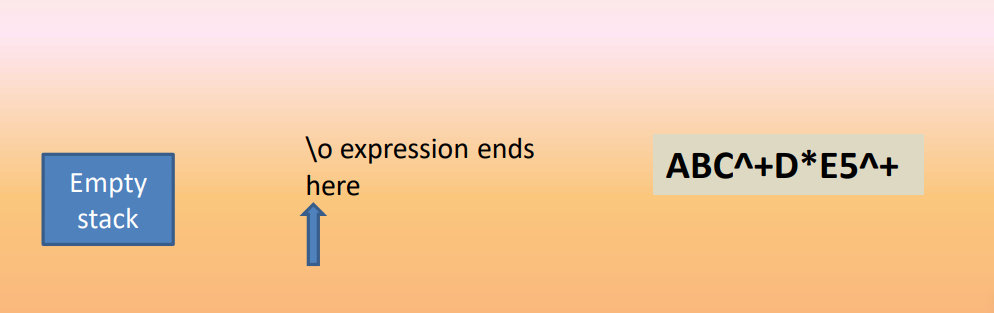
3. Pop all remaining operators
✔ Time Complexity: O(n)
✔ Space Complexity: O(n)
💻 C++ Implementation
#include <iostream>
#include <stack>
using namespace std;

// Function to return precedence of operators
int precedence(char op) {
    if(op == '^') return 3;
    if(op == '*' || op == '/') return 2;
    if(op == '+' || op == '-') return 1;
    return 0;
}

bool isOperator(char c) {
    return (c=='+' || c=='-' || c=='*' || c=='/' || c=='^');
}

// Function to convert infix to postfix
string infixToPostfix(string infix) {
    stack<char> s;
    string postfix = "";

    for(char c : infix) {
        if((c >= 'A' && c <= 'Z') || (c >= 'a' && c <= 'z') || (c >= '0' && c <= '9')) {
            // Operand
            postfix += c;
        }
        else if(c == '(') {
            s.push(c);
        }
        else if(c == ')') {
            while(!s.empty() && s.top() != '(') {
                postfix += s.top();
                s.pop();
            }
            if(!s.empty()) s.pop(); // Remove '('
        }
        else if(isOperator(c)) {
            while(!s.empty() && precedence(s.top()) >= precedence(c)) {
                postfix += s.top();
                s.pop();
            }
            s.push(c);
        }
    }

    while(!s.empty()) {
        postfix += s.top();
        s.pop();
    }

    return postfix;
}

int main() {
    string infix = "A+B*(C-D)";
    cout << "Infix Expression: " << infix << endl;
    cout << "Postfix Expression: " << infixToPostfix(infix) << endl;
    return 0;
}
🔹 Sample Input & Output
Input:
A + B * (C – D)
Output:
A B C D – * +
✅ Key Points
-
Stack stores operators temporarily.
-
Operands are added immediately to the output.
-
Handles parentheses and precedence automatically.
-
Can be extended to evaluate numeric postfix expressions.
💡 Advantages of Postfix Expressions
-
No parentheses required
-
Evaluation is faster
-
Suitable for stack-based computation
Interview Questions & Answers – Infix to Postfix Using Stack
-
What is the difference between infix and postfix expressions
-
Infix: Operators are between operands (e.g.,
A + B) -
Postfix: Operators come after operands (e.g.,
A B +)
-
Why do we use postfix expressions?
Postfix expressions do not require parentheses and are easier to evaluate using a stack. -
What is a stack’s role in converting infix to postfix?
A stack temporarily stores operators while operands are added immediately to the postfix expression.
-
How do you handle operator precedence in infix to postfix conversion?
Before pushing a new operator onto the stack, pop all operators from the stack with higher or equal precedence to ensure correct order in postfix. -
How are parentheses handled?
-
(is pushed onto the stack -
)causes operators to pop from the stack until(is encountered
-
What is the time complexity of infix to postfix conversion?
O(n), where n is the number of characters in the expression. -
Can the algorithm handle multi-digit operands or variables?
Yes, by scanning numbers or variable names as a single token instead of a single character. -
What is the space complexity of infix to postfix conversion?
O(n) for the stack, where n is the number of operators in the expression. -
Why is a stack suitable for expression evaluation?
Because stacks follow LIFO, they naturally handle nested expressions and operator precedence efficiently. -
How would you evaluate a postfix expression after conversion?
-
-
Use a stack:
-
Push operands to the stack
-
On encountering an operator, pop the required number of operands, perform operation, and push result back.
-
What could go wrong if you forget to pop operators after processing the entire infix expression?
The resulting postfix expression would be incorrect and may cause runtime errors during evaluation. -
Why is this algorithm commonly used in compilers?
Because postfix simplifies machine-level evaluation and removes the need for parentheses in parsing expressions.
-
Visit Next Lesson 11: Introduction to Queue
If you are learning and enjoying, subscribe to our blog for daily updates.