
Sorting Algorithms Explained: Bubble Sort, Insertion Sort, and Selection Sort with Examples
Introduction to Sorting Algorithms
Sorting algorithms are among the most fundamental concepts in Computer Science and software development. Whether you are building an e-commerce website, managing student records, processing banking transactions, or analyzing large datasets, sorting plays a critical role in organizing data efficiently.
Imagine searching for a student’s result in a randomly arranged list of thousands of records. It would take much longer compared to searching through an alphabetically sorted list. That is exactly why sorting algorithms are essential.
In this blog, you will learn:
- What sorting algorithms are
- Why sorting is important
- Bubble Sort
- Insertion Sort
- Selection Sort
- Real-world applications
- Step-by-step examples
- Time complexity comparison
- Advantages and disadvantages
- Practical use cases
What is a Sorting Algorithm?
A sorting algorithm is a method used to arrange data in a specific order, usually:
- Ascending order (smallest to largest)
- Descending order (largest to smallest)
For example:
Unsorted Array:
45, 12, 89, 23, 7
Sorted Array (Ascending):
7, 12, 23, 45, 89
Sorting improves:
- Searching efficiency
- Data organization
- Performance of other algorithms
- User experience in applications
Why Are Sorting Algorithms Important?
Sorting algorithms are widely used in:
| Application Area | Example |
|---|---|
| E-commerce | Sorting products by price |
| Banking Systems | Sorting transactions |
| Universities | Sorting student records |
| Social Media | Sorting posts by popularity |
| Data Science | Organizing datasets |
| Search Engines | Ranking search results |
1. Bubble Sort
What is Bubble Sort?
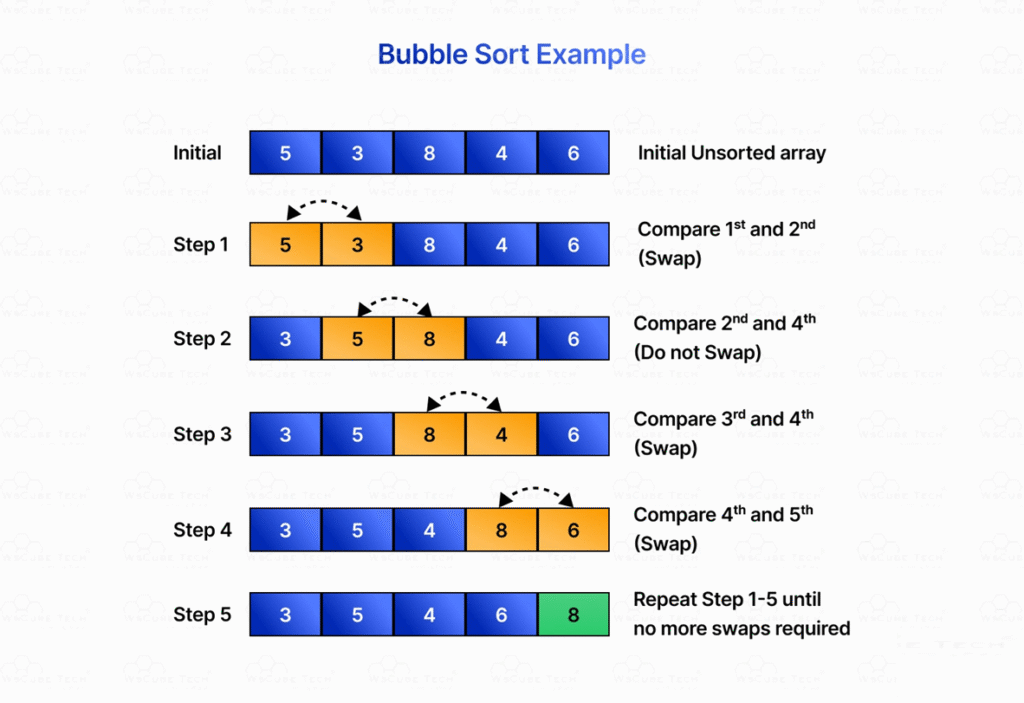
Bubble Sort is the simplest sorting algorithm that repeatedly compares adjacent elements and swaps them if they are in the wrong order.
The larger values “bubble up” toward the end of the list after every iteration.
How Bubble Sort Works
Suppose we have the array:
5, 1, 4, 2, 8
Pass 1
Compare adjacent elements:
- 5 and 1 → Swap
- 5 and 4 → Swap
- 5 and 2 → Swap
- 5 and 8 → No Swap
Result:
1, 4, 2, 5, 8
Pass 2
- 1 and 4 → No Swap
- 4 and 2 → Swap
- 4 and 5 → No Swap
Result:
1, 2, 4, 5, 8
Now the array is sorted.
Bubble Sort Algorithm:
Repeat until array is sorted:
Compare adjacent elements
Swap if left element > right element
Bubble Sort C++ Code
#include <iostream>
using namespace std;

void bubbleSort(int arr[], int n) {
    for(int i = 0; i < n - 1; i++) {

        for(int j = 0; j < n - i - 1; j++) {

            if(arr[j] > arr[j + 1]) {

                swap(arr[j], arr[j + 1]);
            }
        }
    }
}

int main() {

    int arr[] = {5, 1, 4, 2, 8};
    int n = 5;

    bubbleSort(arr, n);

    cout << "Sorted Array: ";

    for(int i = 0; i < n; i++) {
        cout << arr[i] << " ";
    }

    return 0;
}
Real-Life Example of Bubble Sort
Imagine students standing in a line according to height. Adjacent students compare heights and swap positions if necessary. After several rounds, students become arranged from shortest to tallest.
Advantages of Bubble Sort
- Easy to understand
- Simple implementation
- Good for beginners
Disadvantages of Bubble Sort
- Very slow for large datasets
- High number of comparisons
- Inefficient in real-world systems
Time Complexity of Bubble Sort
| Case | Complexity |
|---|---|
| Best Case | O(n) |
| Average Case | O(n²) |
| Worst Case | O(n²) |
2. Insertion Sort
What is Insertion Sort?
Insertion Sort works similarly to arranging playing cards in your hands.
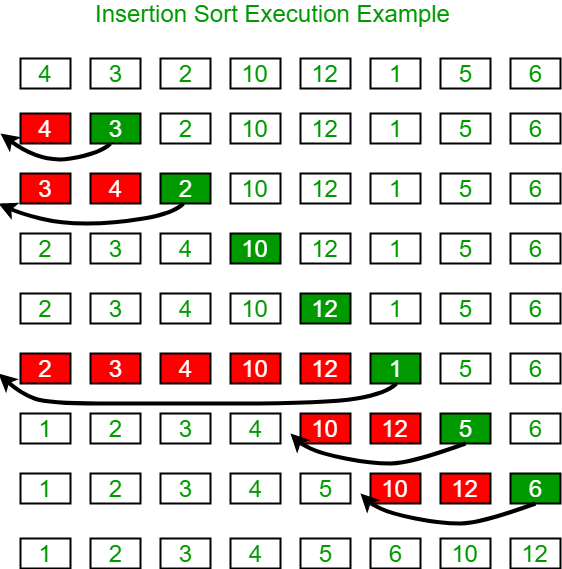
It takes one element at a time and inserts it into the correct position within the sorted portion of the array.

How Insertion Sort Works
Array:
5, 2, 4, 6, 1, 3
Step 1
Take 2 and compare with 5.
Swap:
2, 5, 4, 6, 1, 3
Step 2
Take 4 and place it correctly.
2, 4, 5, 6, 1, 3
Step 3
Continue until all elements are sorted.
Final Result:
1, 2, 3, 4, 5, 6
Insertion Sort Algorithm
Start from second element
Compare with previous elements
Insert into correct position
Repeat until array is sorted
Insertion Sort C++ Code
#include <iostream>
using namespace std;

void insertionSort(int arr[], int n) {

    for(int i = 1; i < n; i++) {

        int key = arr[i];
        int j = i - 1;

        while(j >= 0 && arr[j] > key) {

            arr[j + 1] = arr[j];
            j--;
        }

        arr[j + 1] = key;
    }
}

int main() {

    int arr[] = {5, 2, 4, 6, 1, 3};
    int n = 6;

    insertionSort(arr, n);

    cout << "Sorted Array: ";

    for(int i = 0; i < n; i++) {
        cout << arr[i] << " ";
    }

    return 0;
}
Real-Life Example of Insertion Sort
Suppose a teacher arranges student answer sheets according to roll numbers. Each new sheet is inserted into its correct position among already sorted sheets.
Advantages of Insertion Sort
- Efficient for small datasets
- Adaptive for partially sorted arrays
- Stable sorting algorithm
Disadvantages of Insertion Sort
- Inefficient for large datasets
- More shifting operations
Time Complexity of Insertion Sort
| Case | Complexity |
|---|---|
| Best Case | O(n) |
| Average Case | O(n²) |
| Worst Case | O(n²) |
3. Selection Sort
What is Selection Sort?
Selection Sort repeatedly selects the minimum element from the unsorted portion and places it at the beginning.
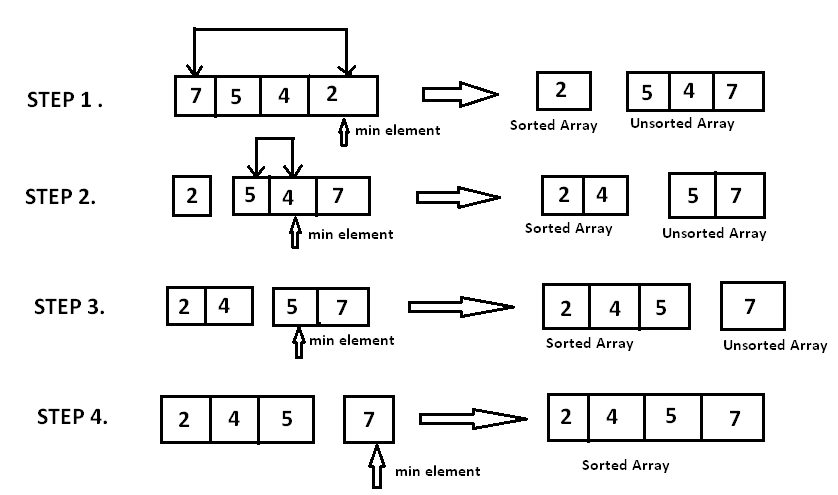
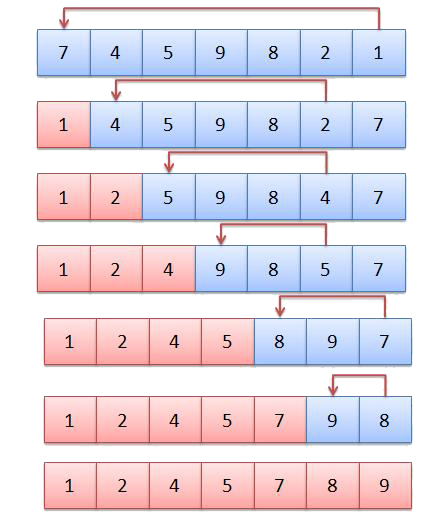
How Selection Sort Works
Array:
64, 25, 12, 22, 11
Pass 1
Find minimum element = 11
Swap with first element.
11, 25, 12, 22, 64
Pass 2
Find next minimum = 12
11, 12, 25, 22, 64
Continue until array becomes sorted.
Final Result:
11, 12, 22, 25, 64
Selection Sort Algorithm
Find minimum element
Swap with first unsorted position
Repeat for remaining array
Selection Sort C++ Code
#include <iostream>
using namespace std;

void selectionSort(int arr[], int n) {

    for(int i = 0; i < n - 1; i++) {

        int minIndex = i;

        for(int j = i + 1; j < n; j++) {

            if(arr[j] < arr[minIndex]) {
                minIndex = j;
            }
        }

        swap(arr[i], arr[minIndex]);
    }
}

int main() {

    int arr[] = {64, 25, 12, 22, 11};
    int n = 5;

    selectionSort(arr, n);

    cout << "Sorted Array: ";

    for(int i = 0; i < n; i++) {
        cout << arr[i] << " ";
    }

    return 0;
}
Real-Life Example of Selection Sort
Imagine arranging books on a shelf. You repeatedly select the smallest book and place it at the beginning.
Advantages of Selection Sort
- Easy implementation
- Performs fewer swaps
- Useful for small datasets
Disadvantages of Selection Sort
- Poor efficiency
- Not suitable for large data
Time Complexity of Selection Sort
| Case | Complexity |
|---|---|
| Best Case | O(n²) |
| Average Case | O(n²) |
| Worst Case | O(n²) |
Comparison of Bubble, Insertion, and Selection Sort
| Feature | Bubble Sort | Insertion Sort | Selection Sort |
|---|---|---|---|
| Method | Swapping adjacent elements | Insert into correct position | Select minimum element |
| Best Case | O(n) | O(n) | O(n²) |
| Worst Case | O(n²) | O(n²) | O(n²) |
| Stable | Yes | Yes | No |
| Easy to Learn | Very Easy | Easy | Easy |
| Efficient for Large Data | No | No | No |
Which Sorting Algorithm is Better?
The answer depends on the situation.
| Scenario | Best Choice |
|---|---|
| Very small dataset | Bubble Sort |
| Nearly sorted data | Insertion Sort |
| Minimal swaps required | Selection Sort |
For large-scale applications, advanced algorithms like:
- Merge Sort
- Quick Sort
- Heap Sort
are preferred.
Real-World Applications of Sorting Algorithms
E-Commerce Websites
Products sorted by:
- Price
- Rating
- Popularity
Examples include Amazon and Daraz.
University Management Systems
Student records sorted by:
- Roll numbers
- GPA
- Attendance
Banking Applications
Transactions sorted by:
- Date
- Amount
- Customer ID
Data Analytics
Large datasets are sorted before analysis in tools like:
- Python
- R
- SQL databases
Key Takeaways
- Sorting algorithms organize data efficiently.
- Bubble Sort uses repeated swapping.
- Insertion Sort inserts elements into correct positions.
- Selection Sort selects minimum values repeatedly.
- All three are beginner-friendly algorithms.
- These algorithms are foundational concepts in data structures and algorithms.
Conclusion
Sorting algorithms are essential building blocks in programming and software engineering. Understanding Bubble Sort, Insertion Sort, and Selection Sort helps students strengthen their problem-solving skills and develop a strong foundation in algorithms.
Although these algorithms are not ideal for large-scale systems, they are extremely important for learning the logic behind data organization and algorithm design.
Mastering these basic algorithms prepares you for advanced topics such as:
- Divide and Conquer
- Dynamic Programming
- Graph Algorithms
- Database Optimization
If you are starting your journey in programming or preparing for technical interviews, learning sorting algorithms thoroughly is a must.
Frequently Asked Questions (FAQs)
Which sorting algorithm is easiest to learn?
Bubble Sort is considered the easiest due to its simple swapping mechanism.
Which sorting algorithm is best for nearly sorted arrays?
Insertion Sort performs very efficiently on nearly sorted data.
Why are sorting algorithms important?
They improve searching, data management, and overall application performance.
Is Selection Sort stable?
No, Selection Sort is generally not stable.