Circular Linked List
A Circular Linked List (CLL) is a variation of the linked list in which the last node points back to the first node instead of NULL, forming a circular structure.
Unlike linear linked lists, a circular linked list has no definite beginning or end.

📌 Definition
A Circular Linked List is a linked list where:
-
Each node contains data and a pointer
-
The last node’s next pointer points to the first node
-
Traversal can start from any node
Visit the previous lesson: Doubly Linked List Operations (With C++ Examples)
🧠 Types of Circular Linked List
-
Circular Singly Linked List
-
Circular Doubly Linked List
This section focuses on Circular Singly Linked List, which is most commonly used.
🧩 Structure of a Circular Linked List Node
struct Node {
     int data;
     Node* next;
};
🔍 Key Characteristics
-
No
NULLpointer in the list -
Last node links back to the head
-
Traversal must stop explicitly
-
Efficient for cyclic processes
🌍 Real-World Use Cases
-
Round-robin CPU scheduling
-
Multiplayer games (turn rotation)
-
Music playlists (repeat mode)
-
Traffic light systems
-
Circular buffers
Operations on Circular Linked List
1️⃣ Insert at the Beginning
📌 Explanation
A new node is inserted before the current head, and the last node is updated to point to the new head.
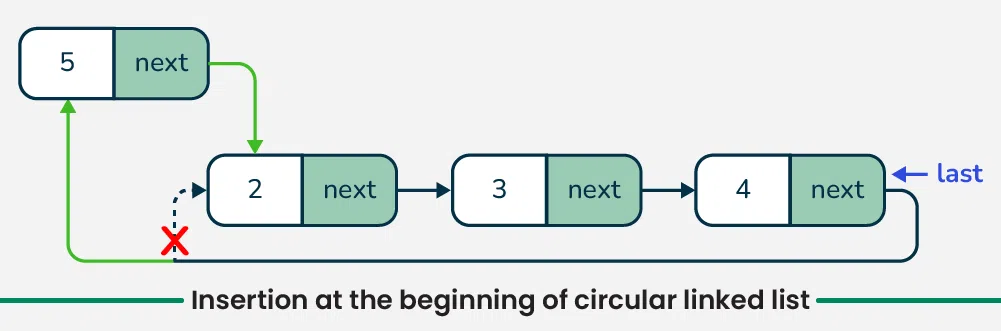
💻 C++ Code
void insertAtStart(Node*& head, int value) {
    Node* newNode = new Node();
    newNode->data = value;

    if (head == nullptr) {
        newNode->next = newNode;
        head = newNode;
        return;
    }

    Node* temp = head;
    while (temp->next != head)
        temp = temp->next;

    temp->next = newNode;
    newNode->next = head;
    head = newNode;
}
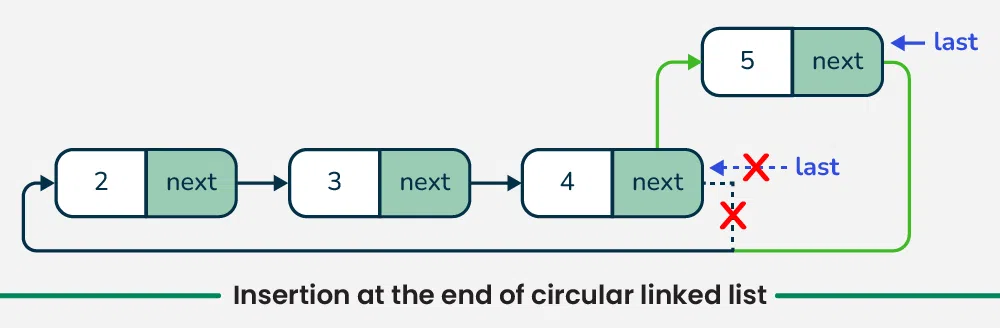
2️⃣ Insert at the End
📌 Explanation
The new node is inserted after the last node, and its next pointer is set to the head.
💻 C++ Code
void insertAtEnd(Node*& head, int value) {
    Node* newNode = new Node();
    newNode->data = value;

    if (head == nullptr) {
        newNode->next = newNode;
        head = newNode;
        return;
    }

    Node* temp = head;
    while (temp->next != head)
        temp = temp->next;

    temp->next = newNode;
    newNode->next = head;
}
3️⃣ Delete from the Beginning
📌 Explanation
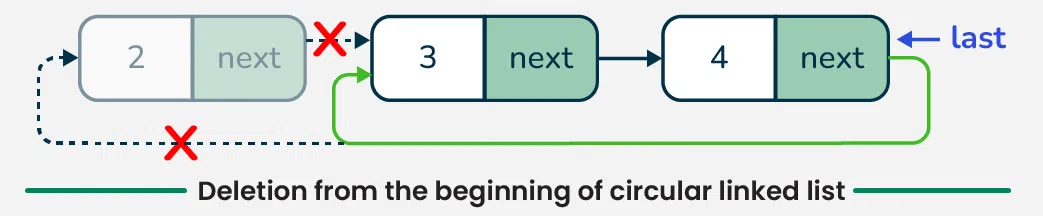
The head node is removed, and the last node’s next pointer is updated.
💻 C++ Code
void deleteFromStart(Node*& head) {
    if (head == nullptr) return;

    if (head->next == head) {
        delete head;
        head = nullptr;
        return;
    }

    Node* temp = head;
    Node* last = head;

    while (last->next != head)
        last = last->next;

    head = head->next;
    last->next = head;
    delete temp;
}
4️⃣ Delete from the End
📌 Explanation
The last node is removed, and the second-last node is linked to the head.

💻 C++ Code
void deleteFromEnd(Node*& head) {
    if (head == nullptr) return;

    if (head->next == head) {
        delete head;
        head = nullptr;
        return;
    }

    Node* prev = nullptr;
    Node* curr = head;

    while (curr->next != head) {
        prev = curr;
        curr = curr->next;
    }

    prev->next = head;
    delete curr;
}
5️⃣ Display Circular Linked List
📌 Explanation
Traversal starts from the head and stops when the head is reached again.

💻 C++ Code
void display(Node* head) {
    if (head == nullptr) return;

    Node* temp = head;
    do {
        cout << temp->data << " ";
        temp = temp->next;
    } while (temp != head);
}
📊 Time Complexity Summary
| Operation | Time Complexity |
|---|---|
| Insert at Start | O(n) |
| Insert at End | O(n) |
| Delete from Start | O(n) |
| Delete from End | O(n) |
| Traversal | O(n) |
✅ Advantages
-
Efficient cyclic traversal
-
No NULL pointers
-
Ideal for round-robin systems
❌ Disadvantages
-
Complex logic
-
Risk of infinite loops
-
No direct backward traversal
🎯 Key Takeaway
A Circular Linked List is best suited for repetitive and cyclic tasks where data needs to be accessed continuously without restarting traversal.
Circular Linked List – Interview Questions & Answers
1. What is a circular linked list?
Answer:
A circular linked list is a linked list in which the last node points back to the first node instead of pointing to NULL, forming a circular structure.
2. How does a circular linked list differ from a singly linked list?
Answer:
In a singly linked list, the last node points to NULL, while in a circular linked list, the last node points to the head node.
3. Why is there no NULL pointer in a circular linked list?
Answer:
Because the list forms a closed loop, where every node points to another node, and the last node points back to the first node.
4. What are the main components of a circular linked list node?
Answer:
Each node contains:
-
Data
-
A pointer to the next node
5. How do you detect the end of traversal in a circular linked list?
Answer:
Traversal stops when the pointer reaches the starting node (head) again.
6. What is the time complexity of traversal in a circular linked list?
Answer:
O(n), where n is the number of nodes.
7. What happens if you forget the stopping condition while traversing?
Answer:
It results in an infinite loop, which can crash the program.
8. Where are circular linked lists used in real life?
Answer:
They are used in:
-
Round-robin CPU scheduling
-
Multiplayer turn-based games
-
Circular queues
-
Music playlists in repeat mode
9. Can you insert a node at the beginning of a circular linked list?
Answer:
Yes, but the last node’s next pointer must be updated to point to the new head.
10. What is the time complexity of inserting at the end?
Answer:
O(n) if no tail pointer is maintained.
11. How do you delete the first node in a circular linked list?
Answer:
-
Locate the last node
-
Move the head to the next node
-
Update the last node’s next pointer
-
Delete the old head
12. What is the advantage of a circular linked list over a singly linked list?
Answer:
It allows continuous traversal without restarting from the head.
13. What is a circular doubly linked list?
Answer:
A circular doubly linked list has:
-
Each node pointing to both previous and next nodes
-
The last node pointing to the first node
-
The first node pointing back to the last node
14. Can a circular linked list be empty?
Answer:
Yes, when the head pointer is set to NULL.
15. How do you count the number of nodes in a circular linked list?
Answer:
By traversing the list until the pointer returns to the head and incrementing a counter.
16. Why is a circular linked list suitable for round-robin scheduling?
Answer:
Because after the last process, control automatically returns to the first process without restarting traversal.
17. Is a circular linked list cache-friendly?
Answer:
No, because nodes are stored in non-contiguous memory locations.
18. What is the biggest risk when working with circular linked lists?
Answer:
The risk of infinite loops due to missing or incorrect termination conditions.
Visit next lesson 09: Introduction to Stack
Are you interested in developing mobile application development skills? You may visit the link below:
https://onlineskilllab.com/2025/11/18/how-to-build-a-complete-flutter-authentication-system-with-firebase-login-signup-reset-password-dashboard/
If you are learning and enjoying, subscribe to our blog for daily updates.