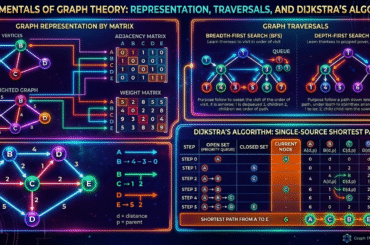
In this article, we will discuss Prim’s algorithm for a Minimum Spanning Tree (MST) with an example. In this article, we will explain Prim’s algorithm for a the Minimum Spanning Tree (MST) with a step-by-step example.
Introduction
One of the most significant optimization problems in graph theory is the problem of discovering Minimum Spanning Tree (MST). The basic idea of a Minimum Spanning Tree is to join all the vertices of a weighted graph together in such a way that the total cost of the edges included in the MST is minimum and there are no cycles.
One of the classical algorithms that solve this problem is Prim’s algorithm which is one of the most popular and timesaving of all algorithms, particularly for dense graphs.
Prim’s Algorithm is a greedy algorithm that constructs the MST one by one starting from an arbitrarily selected vertex and including the smallest possible edges which increase the size of the tree.
What is a Minimum Spanning Tree (MST)?
A spanning tree of a graph is a subgraph that:
- Connects all vertices
- Contains no cycles
- Has exactly V − 1 edges (where V is number of vertices)
A Minimum Spanning Tree (MST) is the spanning tree with the minimum total edge weight.
Key properties:
- Covers all nodes
- No cycles allowed
- Minimum total cost
- Always has V − 1 edges
What is Prim’s Algorithm?
Prim’s Algorithm is a greedy approach used to find MST in a weighted, undirected graph.
Core idea:
Start from any node and repeatedly add the minimum weight edge that connects a visited vertex to an unvisited vertex.
Why is Prim’s Algorithm Important?
Prim’s Algorithm is widely used in:
- Network design (LAN, WAN)
- Road construction planning
- Electrical grid optimization
- Computer networking
- Circuit design
It helps reduce cost while ensuring full connectivity.
Real-Life Scenario: Smart City Road Construction
Imagine a government planning to connect multiple cities with roads:
Cities:
- Lahore
- Faisalabad
- Multan
- Islamabad
- Sahiwal
Each possible road has a construction cost.
The goal is:
Connect all cities with minimum construction cost without building unnecessary roads.
This is exactly an MST problem, solved using Prim’s Algorithm.
How Prim’s Algorithm Works (Step-by-Step)
Let’s understand it clearly.
Step 1: Initialize
- Pick any starting node (e.g., Lahore)
- Mark it as visited
- MST set = empty
Step 2: Select Minimum Edge
Find the smallest edge from visited nodes to unvisited nodes.
Step 3: Add Edge to MST
Include the edge if it connects a new vertex.
Step 4: Repeat
Repeat until all vertices are included.
Example Graph (Conceptual)
Assume the following weighted connections:
- Lahore – Faisalabad = 4
- Lahore – Multan = 2
- Faisalabad – Multan = 5
- Faisalabad – Islamabad = 10
- Multan – Sahiwal = 3
- Sahiwal – Islamabad = 6
Prim’s Algorithm Execution
Start from Lahore
Visited: {Lahore}
Step 1
Choose smallest edge from Lahore:
- Lahore → Multan (2)
Visited: {Lahore, Multan}
Step 2
Check all edges from visited nodes:
- Multan → Sahiwal (3)
Visited: {Lahore, Multan, Sahiwal}
Step 3
Next smallest:
- Lahore → Faisalabad (4)
Visited: {Lahore, Multan, Sahiwal, Faisalabad}
Step 4
Next smallest:
- Sahiwal → Islamabad (6)
Visited: {All cities}
Final MST Cost
Total cost = 2 + 3 + 4 + 6 = 15
Data Structures Used in Prim’s Algorithm
Prim’s Algorithm typically uses:
1. Priority Queue (Min Heap)
Used to get the smallest edge quickly.
2. Visited Array
Tracks visited vertices.
3. Adjacency List / Matrix
Stores graph representation.
Pseudocode of Prim’s Algorithm
1. Initialize all keys = ∞
2. Set key[start] = 0
3. Insert all nodes into priority queue

4. While queue is not empty:
Extract node with minimum key

Mark node as visited

For each adjacent node:
    If edge weight < key[neighbor]:
        Update key[neighbor]
#include <iostream>
#include <vector>
#include <queue>

using namespace std;

typedef pair<int, int> pii;

void primMST(vector<vector<pii>>& graph, int V) {
    priority_queue<pii, vector<pii>, greater<pii>> pq;

    vector<int> key(V, 1e9);
    vector<bool> inMST(V, false);

    key[0] = 0;
    pq.push({0, 0});

    int totalCost = 0;

    while (!pq.empty()) {
        int u = pq.top().second;
        pq.pop();

        if (inMST[u]) continue;

        inMST[u] = true;
        totalCost += key[u];

        for (auto edge : graph[u]) {
            int v = edge.first;
            int weight = edge.second;

            if (!inMST[v] && weight < key[v]) {
                key[v] = weight;
                pq.push({key[v], v});
            }
        }
    }

    cout << "Minimum Cost of MST: " << totalCost << endl;
}

int main() {
    int V = 5;

    vector<vector<pii>> graph(V);

    graph[0].push_back({1, 4});
    graph[1].push_back({0, 4});

    graph[0].push_back({2, 2});
    graph[2].push_back({0, 2});

    graph[1].push_back({2, 5});
    graph[2].push_back({1, 5});

    graph[1].push_back({3, 10});
    graph[3].push_back({1, 10});

    graph[2].push_back({4, 3});
    graph[4].push_back({2, 3});

    graph[4].push_back({3, 6});
    graph[3].push_back({4, 6});

    primMST(graph, V);

    return 0;
}
Time Complexity of Prim’s Algorithm
Using Min Heap:
- O(E log V)
Where:
- E = number of edges
- V = number of vertices
Using adjacency matrix:
- O(V²)
Prim’s Algorithm vs Kruskal Algorithm
| Feature | Prim’s Algorithm | Kruskal Algorithm |
|---|---|---|
| Approach | Vertex-based | Edge-based |
| Structure | Starts from a node | Sort all edges |
| Best for | Dense graphs | Sparse graphs |
| Data Structure | Min Heap | Union-Find |
| Complexity | O(E log V) | O(E log E) |
Advantages of Prim’s Algorithm
- Efficient for dense graphs
- Simple greedy approach
- Works well with adjacency matrix
- Always produces optimal MST
Disadvantages
- Not ideal for sparse graphs
- Requires priority queue implementation
- Slightly complex than Kruskal for beginners
Real-World Applications
Prim’s Algorithm is used in:
1. Internet Network Design
Connecting routers with minimum cable cost
2. Road Construction
Planning cheapest road networks
3. Electrical Grids
Designing efficient power distribution systems
4. Computer Networks
LAN/WAN optimization
5. Circuit Design
Reducing wiring cost in chips
Common Interview Questions
1. What is Prim’s Algorithm?
A greedy algorithm used to find MST by expanding from a starting node.
2. Does Prim’s Algorithm guarantee MST?
Yes, it always produces optimal MST.
3. What is the main difference between Prim and Kruskal?
Prim grows from a node, Kruskal selects edges globally.
Conclusion
Prim’s Algorithm is one of the most fundamental graph algorithms in computer science. It demonstrates how greedy strategies can efficiently solve complex optimization problems like network design.
By starting from a single node and expanding the MST step by step, Prim’s Algorithm ensures:
- Minimum cost
- Full connectivity
- No cycles
For students of data structures and algorithms, mastering Prim’s Algorithm is essential for exams, interviews, and competitive programming.