What Is Artificial Intelligence, and How Does It Work? Explaining AI to Kids
Ever wonder what is AI for kids and how everyday gadgets think? If you want to know how YouTube Kids picks your next show or how a robot vacuum cleans without falling downstairs, here is how artificial intelligence works in simple words.
Ever thought about how YouTube Kids knows what cartoon to play next? Or how a robotic vacuum can sweep around table legs without tumbling down the stairs? These smart gadgets are powered by Artificial Intelligence (AI).
Whether you are a parent trying to explain modern technology to your child, a teacher building an engaging STEM lesson, or a curious young reader, here is a simple guide to AI using familiar gadgets right from daily life.
What Is AI for Kids? The Elementary School Definition
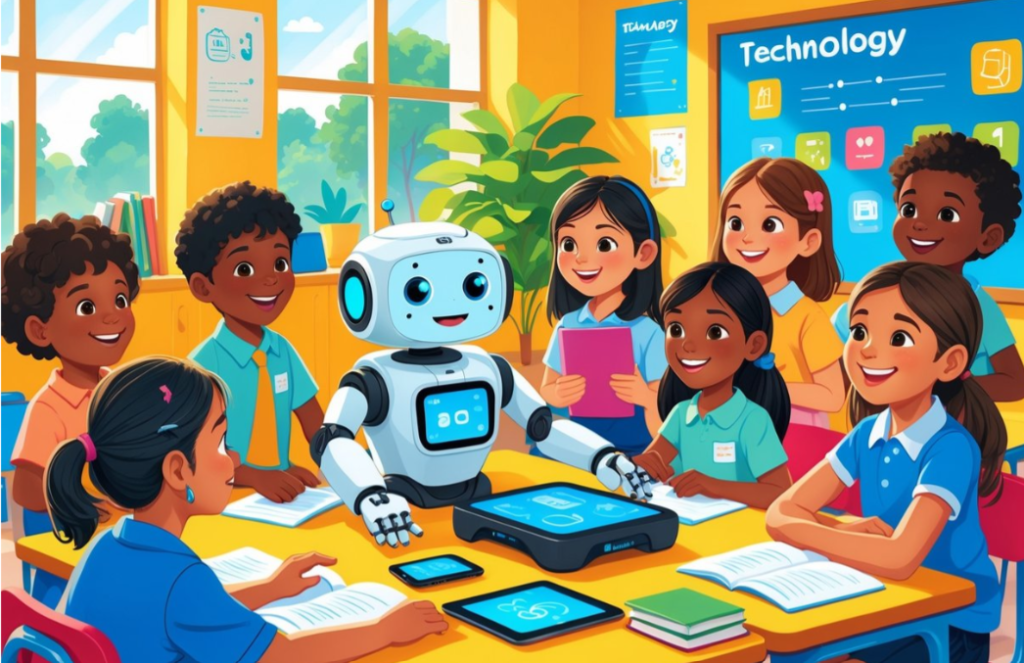
Artificial Intelligence (AI) is computer software taught to think, learn, and solve problems like a human. Instead of just following rigid, pre-written code, an AI program learns from thousands of examples and makes intelligent choices independently.
To understand the difference, compare a standard computer program to a baking recipe:
- Standard Program: If Step 3 says “stir for 2 minutes,” the computer will stir for 2 minutes—even if the bowl is empty!
- AI Program: AI acts like an apprentice cook. It keeps an eye on the ingredients in the bowl, checks whether the batter is smooth, and adapts its actions in real time.
How Does AI Work? The 3-Step Daily Life Cycle
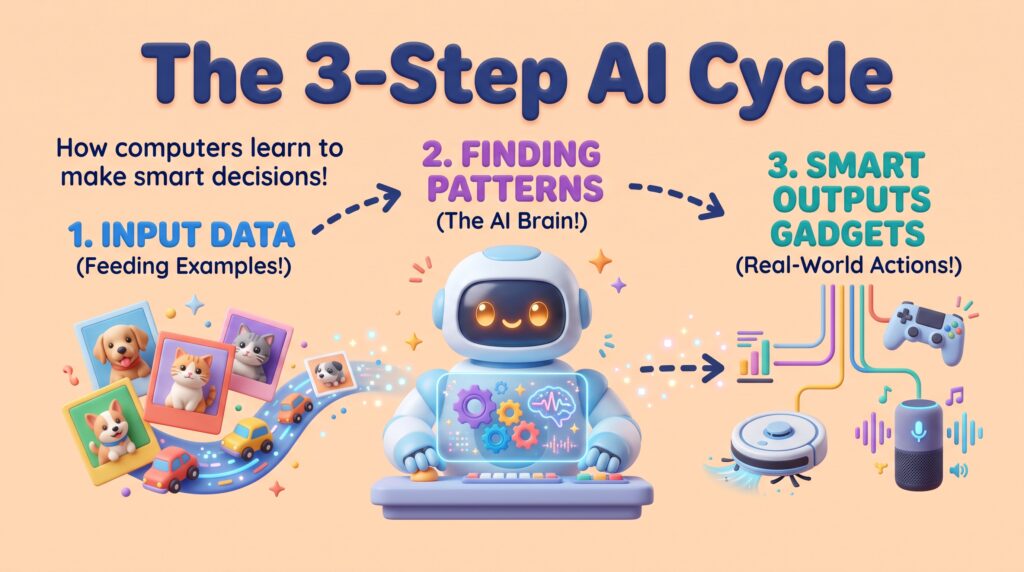
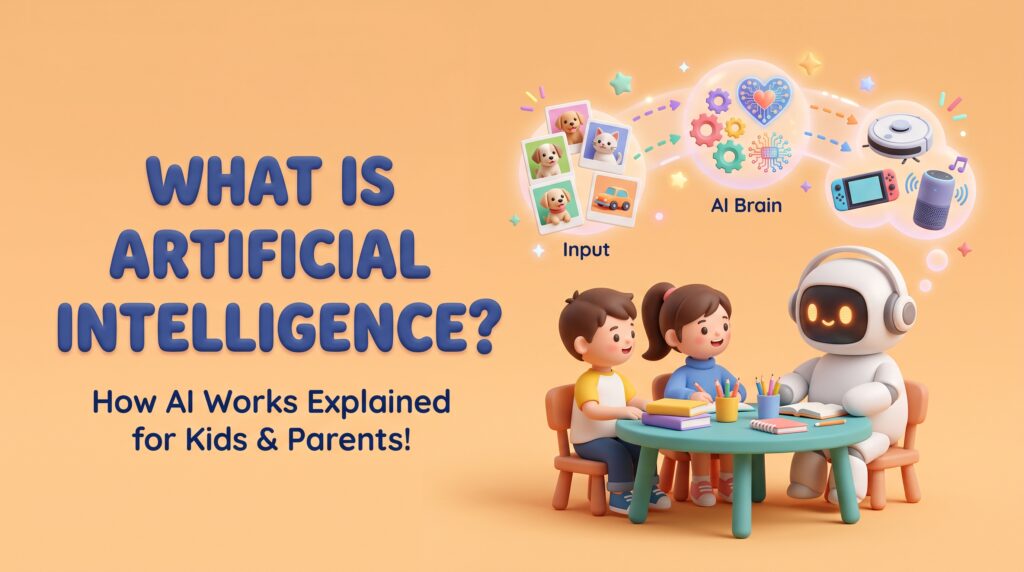
Computers do not have biological brains, nerves, or feelings. Instead, they learn using a process called Machine Learning. Here is the 3-step cycle:
- The Input (Training Data): When you were small, your parents never handed you an instruction manual for a puppy. They simply pointed at a pet in the park and said, “Look, a doggie!” AI learns the exact same way. Programmers feed thousands of photos, audio recordings, or text clips into the computer. This collection of examples is called training data.
- The AI Brain (Finding Patterns): The computer scans through all those examples, searching for shared patterns. When learning to recognize cats, it notes that most cats have pointed ears, whiskers, triangular noses, and furry tails, turning these features into mathematical clues.
- The Output (Making Predictions): When you show the AI a brand-new photo it has never seen, it checks its pattern memory and makes a reasoned guess: “There is a 95% probability this is a kitten.”
4 Simple Examples of AI in Daily Life
1. Streaming Recommendations (Netflix & Disney+)
When you finish an animated movie and your dashboard immediately suggests three similar films you end up loving, that is an AI recommendation engine at work. It compares your watch history with millions of other viewers to predict your tastes.
2. Voice Assistants (Siri & Alexa)
Ask “Hey Alexa, what is the weather today?” and AI uses Natural Language Processing (NLP). It translates spoken sound waves into text, comprehends the question, and returns the correct response in a split second.
3. Smart Vacuum Cleaners (Roomba)
Robotic vacuums use sensors and computer vision to map your floor plan. They recognize school backpacks, steer clear of pet water bowls, and navigate the layout of your living room safely.
4. Video Game Opponents (Minecraft & Mario Kart)
Computer-controlled opponents do not follow a fixed path. They use AI logic to swerve around banana peels, take shortcuts, or react when you build a wall in front of them.
Human vs. AI: What Is the Difference?
While AI is remarkably fast at specific tasks, it is not “smarter” than a human being.
| Capability | Human Brain 🧠 | Artificial Intelligence 🤖 |
|---|---|---|
| Learning Rate | Needs 1 or 2 examples to grasp a concept | Requires thousands of digital data examples |
| Speed | Reads and calculates step-by-step | Scans millions of data points per second |
| Empathy & Feelings | Feels joy, sadness, fairness, and care | Zero feelings, empathy, or conscious thoughts |
| Common Sense | Understands real-world context naturally | Only knows the explicit rules and data it received |
Hands-On AI Activities for Kids
The best way to help children understand AI is to experience it firsthand through interactive play:
- Google Quick Draw!: A free web game where an AI neural network tries to guess what you are doodling before 20 seconds elapse.
- Teachable Machine by Google: An interactive platform where kids use a webcam to train their own computer vision model to recognize hand gestures, colors, or school supplies.
- AutoDraw: A smart sketchpad that predicts what a rough shape is meant to be and instantly converts it into clean, ready-to-use clip art.
Frequently Asked Questions
Is AI alive or conscious?
No. AI is software code running on metal and silicon chips. It cannot think for itself, feel emotions, or make choices outside the rules and data created by human engineers.
What is the difference between a robot and AI?
A robot is the physical machine—the body made of metal, wheels, and gears. AI is the computer software—the brain. A kitchen blender is a machine without AI, while an autonomous Mars rover combines both a physical mechanical body and an AI brain.
Can AI make mistakes?
Yes, frequently. AI does not know anything beyond what it has been taught. If its training data contains inaccurate, biased, or confusing information, its predictions will also be flawed. Human oversight and supervision are always required.